Which type of coffee machine should you buy?
The most important decision is not the brand but the type. Bean-to-cup machines grind and brew automatically, so you get fresh coffee with almost no skill or mess. Manual espresso machines (with or without a built-in grinder) give the best results in the cup if you are willing to learn, but every shot involves dosing, tamping and cleaning. Pod machines are the quickest and tidiest, but you pay much more per cup and you are tied to one capsule system. Pick the type that matches how much effort you will realistically put in at 7am, then choose a model.
Our picks
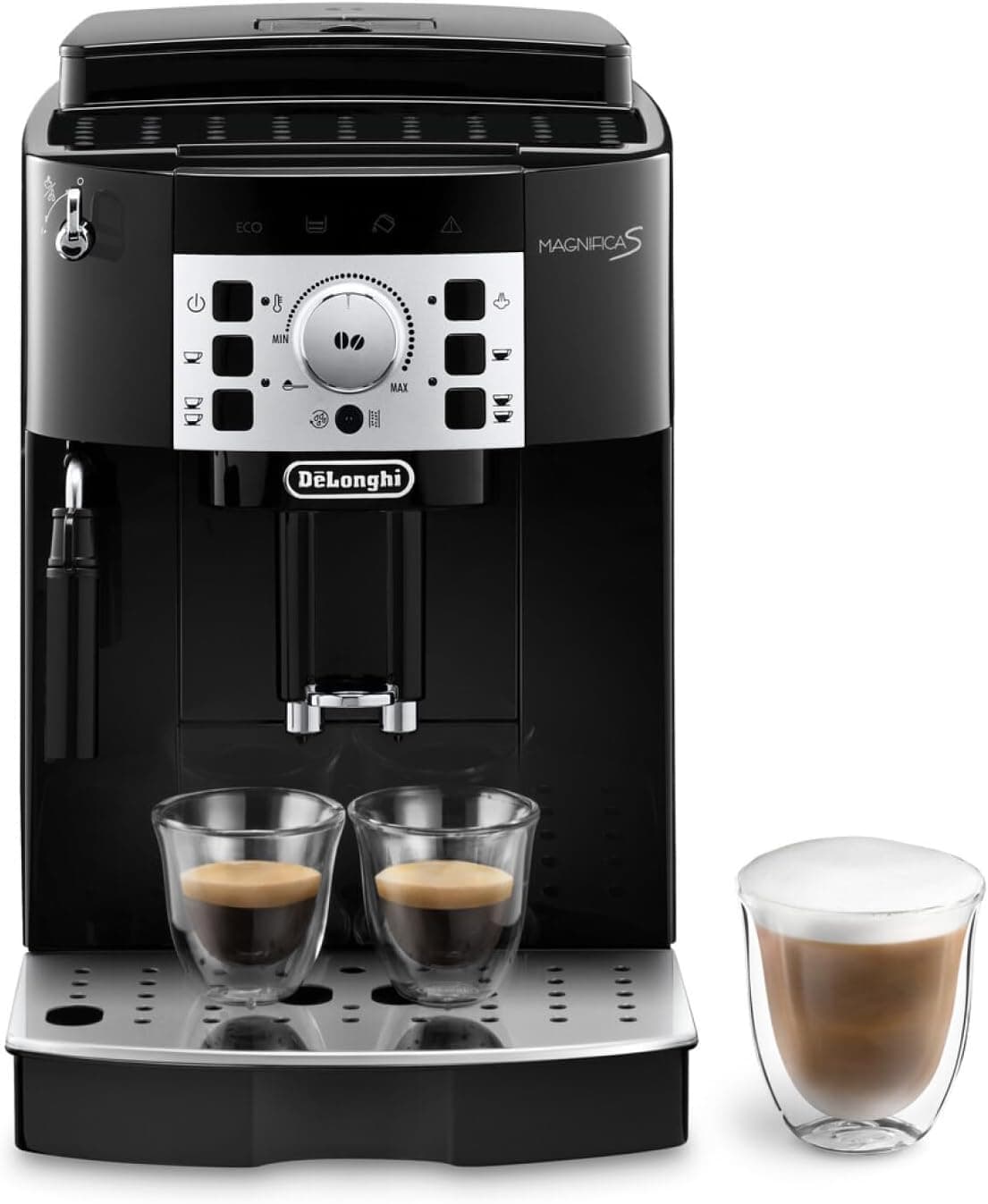
De'Longhi Magnifica S Smart Automatic Bean-to-Cup Coffee Machine with Milk Frother (ECAM22.110.B)
Best for: Households that want fresh-bean coffee with minimal effort.
The De’Longhi Magnifica S (ECAM22.110.B) is a long-running, simple bean-to-cup machine. A built-in conical burr grinder grinds beans for each cup, and front dials set strength and cup size. It has a 15-bar pump, a 1.8-litre water tank and a bean hopper of around 250g, and it can brew two cups at once. Milk is handled by a manual frothing wand rather than an automatic milk system, which keeps it cheaper and easier to clean. The brew unit lifts out to rinse under the tap. It suits anyone who wants fresh-bean espresso and lattes without learning barista technique.
Pros
- One-touch espresso and longer coffees from fresh beans
- Removable brew unit is easy to rinse under the tap
- Separate chute for pre-ground coffee, useful for decaf
- Fewer parts to clean than machines with automatic milk carafes
Cons
- Frothing wand is basic; it makes airy foam rather than fine microfoam
- Less control over the shot than a manual espresso machine
- Small bean hopper by bean-to-cup standards
Other machines worth considering
Links open an Amazon.ie search filtered to items sold & dispatched by Amazon.ie. Availability changes.
- Search Amazon.ie
Sage Barista Express (BES875UK)
Manual espresso machine with a built-in conical burr grinder, PID temperature control, a pressure gauge and a steam wand that can make microfoam with practice; expect a learning curve and more cleaning than bean-to-cup. At the time of writing it’s sold by Amazon UK on Amazon.ie, which can mean import charges, so check the seller before buying.
- Search Amazon.ie
Nespresso Vertuo or Original (e.g. Vertuo Pop, Essenza Mini)
Vertuo machines read a barcode on each pod to brew several cup sizes, but only take Nespresso’s own capsules; the compact Original machines are espresso-only, and that capsule format is also sold by other brands and supermarkets.
- Search Amazon.ie
Philips LatteGo bean-to-cup (2200 / 3200 series)
Bean-to-cup machines with a two-part automatic milk system that is quick to rinse; an alternative if you want one-touch cappuccino.
- Search Amazon.ie
De’Longhi Dedica (EC685)
Slim manual espresso machine, 15cm wide; needs pre-ground coffee or a separate grinder.
- Search Amazon.ie
Sage Bambino Plus
Compact manual espresso machine with a fast heat-up and an automatic steam wand; no built-in grinder.
The Dublin Drop — Friday Deals
Price drops on Amazon.ie stock, once a week. No customs fees, no spam.
Free. No spam. Unsubscribe anytime. We only send verified domestic deals.
How the main types compare
| De’Longhi Magnifica S (our pick) | Manual espresso with grinder (e.g. Sage Barista Express) | Pod machine (e.g. Nespresso) | |
|---|---|---|---|
| Type | Bean-to-cup (automatic) | Manual espresso with grinder | Capsule |
| Grinder | Built-in conical burr | Built-in conical burr | None needed |
| Pump pressure | 15 bar | Barista Express: 15 bar | Varies by system |
| Water tank | 1.8 litres | Barista Express: 2 litres | Typically 0.6–1.1 litres |
| Milk | Manual frothing wand | Manual steam wand | Separate frother (e.g. Aeroccino) or none |
| Skill needed | Low | Moderate to high | None |
| Daily cleaning | Empty grounds and drip tray, rinse wand | Knock out puck, wipe group, purge wand | Empty capsule container |
| Cost per cup | Low (beans) | Low (beans) | Highest (capsules) |
Cost per cup: beans vs pods
Whole beans are almost always the cheapest way to make good coffee at home. A single espresso uses roughly 7–9g of ground coffee and a double around 14–18g, so a 1kg bag makes somewhere between 55 and 70 doubles. As a worked example, beans bought at €20 per kg cost about 32c for a 16g double shot, and beans at €40 per kg (typical of smaller specialty roasters) about 64c. Capsules usually contain only around 5–6g of coffee for an espresso, so per gram of coffee they work out several times more expensive than beans.
That gap is why a pricier bean-to-cup or espresso machine can pay for itself if you drink two or three coffees a day, while a cheap pod machine can be the better buy for someone who makes one coffee most mornings. Electricity is a minor part of the cost; the bigger extras are milk, descaler and, for machines that take one, replacement water filters. Buying beans in 1kg bags and storing them sealed, away from heat and light, keeps the per-cup cost down without losing much freshness if you get through them in a few weeks.
Hard water and descaling in Irish homes
Hard water is common in Irish drinking supplies. Hardness comes mainly from water passing through limestone, which underlies much of the midlands and other parts of the country, so groundwater-fed supplies in those areas tend to be harder, while supplies drawn from upland and granite catchments are often softer. Hardness varies by water supply zone rather than county, so the reliable way to check is to enter your Eircode on Uisce Éireann’s water supply lookup, which reports calcium carbonate levels for your zone.
- Set the hardness on the machine. Bean-to-cup machines such as the Magnifica S let you set water hardness so the descale warning comes up at the right interval. Use the test strip supplied with the machine or your supply zone result.
- Use the water filter if there is one. Some machines, such as the Sage Barista Express, take a filter in the tank; replacing it on schedule reduces scale build-up between descales.
- Descale when prompted, with the right product. Use the manufacturer’s descaler or one specified as suitable. Vinegar is not recommended by most manufacturers, as it can damage seals and is hard to rinse out fully.
- Do not use fully softened water from a salt-based softener unless the manufacturer says it is fine; very soft or sodium-softened water can affect taste and some machines advise against it. Filtered or bottled water with moderate mineral content is the safest alternative.
Milk: frothing wands, steam wands and automatic systems
If most of your coffees are lattes, cappuccinos or flat whites, the milk system matters as much as the coffee. A frothing wand with a sleeve (as on the Magnifica S) draws air in automatically and is forgiving, but it makes bigger bubbles: good for cappuccino foam, less good for a silky flat white. A traditional steam wand (as on manual espresso machines such as the Sage Barista Express) takes practice but can produce fine microfoam. Automatic milk systems, such as carafes or Philips LatteGo, make one-touch milk drinks, at the cost of more parts to rinse after every use.
Whatever system you have, purge and wipe the wand straight after steaming; dried milk blocks the holes quickly. Fresh, cold whole milk froths most easily, and barista versions of oat milk are designed to steam better than standard plant milks.
More buying tips
- Measure under your cupboards. Allow height to lift the lid of the bean hopper or water tank; bean-to-cup and grinder machines are taller than they look in photos.
- Check the tank access. A tank that lifts out from the front or top is far easier to refill than one at the back.
- Think about decaf. A pre-ground chute (as on the Magnifica S) or a manual machine’s portafilter lets you make the odd decaf without emptying the hopper.
- Budget for extras. Descaler, filters, a milk jug and, for manual espresso, a knock box and scales.
Our catalog pick is sold and dispatched by Amazon.ie, so it arrives with an Irish/UK plug and no import charges; for the alternatives, check the seller on the listing, and see why we only list Amazon.ie stock. Browse more in Home & Kitchen, or see our air fryer guide.