What an air purifier can and cannot do
An air purifier pulls room air through a fine filter and traps what is floating in it: pollen, house dust, pet dander, mould spores and fine smoke particles. Run in the room you spend most time in, usually the bedroom, it can make a real difference in hay fever season or in a home with pets. What it does not do is remove moisture, so it will not stop condensation or the black mould that comes with it. That is a dehumidifier’s job.
There is an Irish angle too. The EPA’s air monitoring identifies fine particulate matter (PM2.5), mainly from burning solid fuel in homes, as one of the two main threats to air quality in Ireland, with poor-air episodes most common in cold, still weather from late autumn to early spring. If you live where many houses burn solid fuel, or you have a stove yourself, a HEPA purifier can reduce the level of those fine particles indoors.
The one relevant product in our catalog is a dehumidifier with a built-in H13 HEPA filter, so the dedicated purifiers below link to Amazon.ie search results.
Our pick and the alternatives
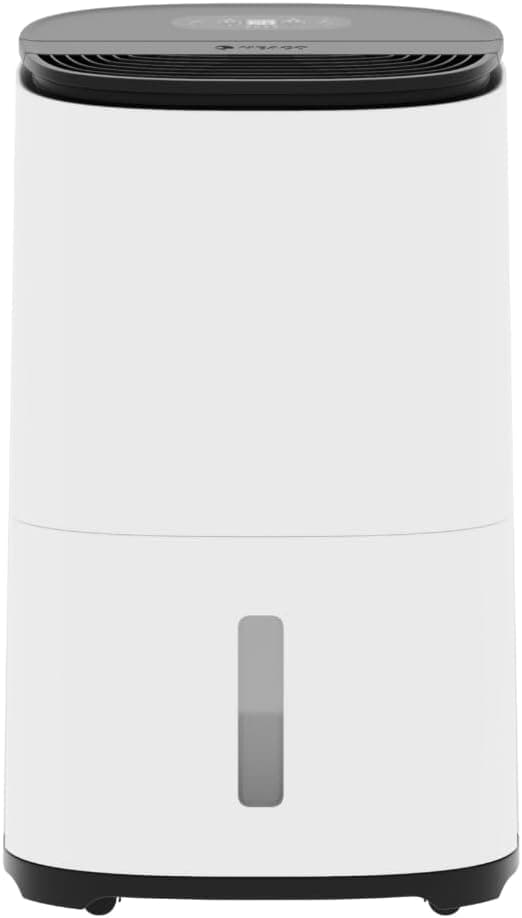
Meaco Arete One 20L Dehumidifier and Medical-Grade H13 HEPA Air Purifier (Low Energy)
Best for: Damp homes where dust, mould spores or pet allergens are also a problem
If your home has condensation as well as dust or allergy problems, one machine can tackle both. The MeacoDry Arete One 20L is a compressor dehumidifier first, but the air it treats passes through a medical-grade H13 HEPA filter, and Meaco says it can be used as a stand-alone air purifier in spring and summer when damp is less of an issue. Meaco quotes 38–40 dB and airflow of around 145–160 m³/h. Meaco does not publish a CADR, so it is not a like-for-like substitute for a dedicated purifier, but in a damp Irish house it saves buying two appliances.
Pros
- Removes moisture and filters airborne particles in one appliance
- H13 HEPA filter, the grade most dedicated purifiers aim for
- Quiet for a dehumidifier, with a night mode
- Laundry mode for drying clothes indoors
Cons
- No published CADR, which makes comparison with dedicated purifiers difficult
- Much bigger and heavier than a bedroom purifier, and draws around 180–225 W when dehumidifying
- Meaco suggests replacing the HEPA filter roughly every three months for the cleanest air, so check the current filter price
Dedicated air purifiers worth considering
Links open an Amazon.ie search filtered to items sold & dispatched by Amazon.ie. Availability changes.
- Search Amazon.ie
Levoit Core 300S
A compact cylindrical purifier with a three-stage filter (pre-filter, HEPA and activated carbon), a CADR listed at around 240 m³/h in European listings, a laser air-quality sensor with an auto mode, and VeSync app control over 2.4 GHz Wi-Fi. It suits a bedroom or a small living room. Downside: the top fan speed is loud enough to be distracting at night, so you will mostly run it on auto or sleep, and filters are a recurring cost (check the current filter price).
- Search Amazon.ie
Levoit Core Mini
A small, low-power purifier (around 7 W) for a desk, bedside table or nursery shelf, with an aroma pad for essential oils. It suits close-range use in a small bedroom or home office. Downside: its CADR, quoted at roughly 58–78 m³/h depending on the market, is too low to clean a full-size room quickly, and the filter grade differs between regional versions, so check the listing.
- Search Amazon.ie
Levoit LV-H128
A desktop purifier of similar size and power to the Core Mini (around 6 W), with a three-stage HEPA filter, an aroma pad and a quiet sleep mode with the display switched off. Levoit’s manual gives an ideal room size of about 15 m². Downside: like any desktop unit it works best at close range rather than across a whole room, and there is no air-quality sensor or app.
The Dublin Drop — Friday Deals
Price drops on Amazon.ie stock, once a week. No customs fees, no spam.
Free. No spam. Unsubscribe anytime. We only send verified domestic deals.
How they compare
| Levoit Core 300S | Levoit Core Mini | Levoit LV-H128 | Meaco Arete One 20L | |
|---|---|---|---|---|
| Type | Dedicated purifier | Desktop purifier | Desktop purifier | Dehumidifier with H13 HEPA filter |
| CADR | about 240 m³/h | about 58–78 m³/h | about 50–70 m³/h | Not published (airflow 145–160 m³/h) |
| Best suited to | Bedroom or small living room | Desk or bedside | Desk, bedside or box room | Damp rooms; whole floor as a dehumidifier |
| Rated power | about 23–26 W | about 7 W | about 6 W | 179–225 W when dehumidifying |
| Air-quality sensor | Yes | No | No | No (humidistat only) |
| App control | Yes (Wi-Fi) | No | No | No |
| Removes moisture | No | No | No | Yes |
Buying advice for Irish homes
HEPA grades. Under the European filter standard EN 1822, an H13 filter must capture at least 99.95% of particles at the size that is hardest to trap, and H14 at least 99.995%. “True HEPA” is a US-style term, usually meaning 99.97% at 0.3 microns, rather than an EU grade, and vaguer labels such as “HEPA-type” tell you little. An activated carbon layer helps with cooking and smoke smells but does nothing for particles. Avoid any device sold as an ozone generator: ozone irritates the lungs.
CADR and room size. CADR (clean air delivery rate) is how many cubic metres of filtered air a purifier delivers per hour on its top setting. Multiply your floor area by the ceiling height to get the room volume, then by the number of air changes per hour you want. For allergy relief, a common benchmark is close to five air changes an hour, which is what the US appliance body AHAM’s sizing rule is built on. Room sizes in product listings often assume only one or two air changes, so they can look generous.
| Room | Floor area | Volume | CADR needed |
|---|---|---|---|
| Box room or nursery | about 7 m² | about 17 m³ | about 85 m³/h |
| Double bedroom | about 12 m² | about 29 m³ | about 145 m³/h |
| Living room | about 20 m² | about 48 m³ | about 240 m³/h |
| Open-plan kitchen-living area | about 30 m² | about 72 m³ | about 360 m³/h |
On that basis, a Core 300S has the capacity for a bedroom or a modest living room, while the Core Mini and LV-H128 are close-range desk and bedside units. Buying more CADR than you need and running the purifier on a lower, quieter speed is usually better than running a small unit flat out.
Pollen season. In Ireland, tree pollen such as birch is mostly a spring problem, roughly from late March to May, and grass pollen, the most common hay fever trigger, typically peaks from June into July. Met Éireann publishes pollen forecasts during the season. For the best effect, run the purifier in the bedroom with the window and door closed for a couple of hours before bed, and wash bedding often. A purifier helps indoors only; it will not help when you are out.
Stoves and open fires. A HEPA purifier captures fine smoke particles and a carbon layer reduces the smell, but neither does anything about carbon monoxide. Keep a working CO alarm in any room with a stove or open fire, and treat a purifier as an extra, not a substitute for proper ventilation.
Running costs. Purifiers use little electricity. At around 32c per kWh at the time of writing, a Core 300S drawing about 25 W costs under 1c an hour, or roughly 19c a day if it ran flat out around the clock; in auto mode it spends most of its time on lower speeds. A 6–7 W desktop unit costs about 5c a day running constantly. The Arete One is different: it draws around 216 W when dehumidifying, about 7c an hour, although its compressor switches off once the room reaches its target humidity.
Filter replacement. The filter, not the electricity, is the real running cost. Levoit suggests replacing the Core 300S filter every six to eight months, and Meaco suggests about every three months on the Arete One for the cleanest air; pets, smoke and 24-hour use shorten that. Check the current filter price before you choose a purifier, and favour models whose genuine filters are easy to find. Vacuum or rinse any washable pre-filter every couple of weeks so the main filter lasts longer.
Placement. Put the purifier in the room you use most, keep it clear of walls and curtains as the manual directs, and close the door so it is not trying to clean the whole house. We only link to items sold and dispatched by Amazon.ie, for the reasons in why we only list Amazon.ie stock.