
Do you need a dehumidifier?
If you wake up to streaming windows, find black spots creeping along the top of a bedroom wall, or have clothes that take two days to dry on the horse, the answer is probably yes. Irish winters are mild and wet, and a modern, well-sealed house traps the moisture from showers, cooking, breathing and indoor laundry. A dehumidifier pulls that water out of the air before it settles on the coldest surface in the room.
This guide focuses only on dehumidifiers: the two main technologies, how big a unit you need, what one costs to run at Irish electricity prices, and which models make sense for different homes. It is not a substitute for fixing a leak, rising damp or a blocked vent, but for everyday condensation it is one of the most effective appliances you can buy.
Our pick and the alternatives
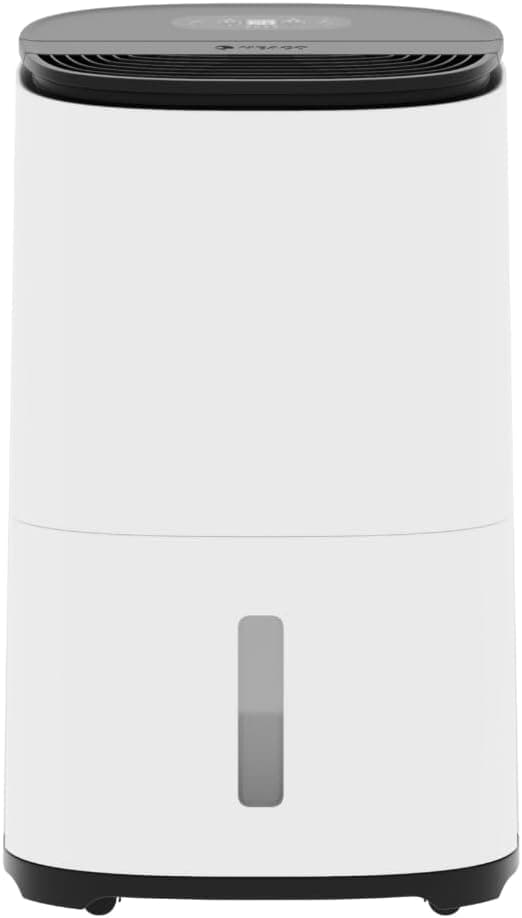
Meaco Arete One 20L Dehumidifier and Medical-Grade H13 HEPA Air Purifier (Low Energy)
Best for: Heated family homes with regular condensation and indoor laundry
The MeacoDry Arete One 20L is a compressor dehumidifier that removes up to 20 litres a day under test conditions and adds an H13 HEPA filter, so it also captures dust and mould spores as it runs. Meaco quotes around 40 dB in its quietest setting and a rated draw of roughly 216 W, which works out at around 7c an hour at typical Irish unit rates. A dedicated laundry mode runs it continuously next to a clothes horse. For a three- or four-bedroom house with a condensation problem, it is the size and type we would start with.
Pros
- 20 litres/day capacity is enough for a whole floor of a typical semi-d when moved between rooms
- Low rated power draw for its capacity keeps running costs modest
- H13 HEPA filter adds air purification without a second appliance
- Laundry mode and humidistat make it easy to set and forget
Cons
- Like all compressor units, extraction falls off noticeably in an unheated room below about 10–15°C
- Bulkier and heavier than a 10–12 litre unit, so carrying it upstairs gets old
- Replacement HEPA filters are an ongoing cost
Other dehumidifiers worth considering
Links open an Amazon.ie search filtered to items sold & dispatched by Amazon.ie. Availability changes.
- Search Amazon.ie
Meaco DD8L Zambezi (desiccant)
A desiccant unit that keeps working in cold rooms, garages and holiday homes. Lower rated capacity than a 20L compressor and higher power use on its top setting, but it adds a little warmth to the room.
- Search Amazon.ie
MeacoDry ABC 12L
A smaller, lighter compressor model for apartments or a single problem bedroom, from the same manufacturer as our main pick.
- Search Amazon.ie
De'Longhi Tasciugo AriaDry Light DEX216F
A compact compressor dehumidifier from a mainstream brand, suited to one or two rooms rather than a whole house.
- Search Amazon.ie
Pro Breeze 12L compressor dehumidifier
A budget-friendly compressor option for smaller spaces. Check the listing for the warranty length and whether a continuous-drain hose is included.
The Dublin Drop — Friday Deals
Price drops on Amazon.ie stock, once a week. No customs fees, no spam.
Free. No spam. Unsubscribe anytime. We only send verified domestic deals.
Compressor vs desiccant at a glance
| Compressor (e.g. Arete One 20L) | Desiccant (e.g. Meaco DD8L) | |
|---|---|---|
| How it works | Cold coil condenses water out of the air | Absorbent wheel soaks up moisture, heater drives it off |
| Best room temperature | Heated rooms, roughly 15°C and up | Cold rooms, garages, sheds, unheated holiday homes |
| Typical power draw | Around 150–250 W | Around 300–650 W depending on setting |
| Effect on room temperature | Slight warming | Noticeable warming (a few degrees) |
| Noise | Compressor hum; quieter models around 40 dB | Fan noise only, no compressor |
| Weight | Heavier | Lighter |
| Best for | Everyday condensation in a lived-in home | Cold spaces and winter laundry in unheated rooms |
Buying advice for Irish homes
Know your target humidity. Ireland's building regulations guidance on condensation (Technical Guidance Document L) notes that when relative humidity stays above about 70% for prolonged periods, mould growth on cold surfaces becomes highly likely, and Department of Education guidance on mould in schools aims to keep rooms below 60%. In practice, setting a dehumidifier's humidistat to around 50–55% in winter keeps you comfortably clear of the danger zone without over-drying the air. A cheap digital hygrometer in each bedroom tells you whether you have a problem before the mould does.
Compressor or desiccant? Most Irish homes with central heating suit a compressor model: it uses less electricity for the water removed when the room is reasonably warm. Compressor units lose efficiency as the temperature drops, so for an unheated box room, a garage, a mobile home or a holiday house that sits cold all winter, a desiccant unit is the better tool. Desiccants also gently warm the space, which helps laundry dry but costs more per hour.
Sizing in litres per day. Capacity figures are measured in warm, very humid lab conditions (often 30°C and 80% RH), so you will see far less than the headline number in a 19°C Irish sitting room. As a rough guide, a 10–12 litre unit suits an apartment or one or two problem rooms, while a 20 litre unit suits a three- or four-bed house or a home that dries most of its laundry indoors. Buying one size up and running it on a lower fan speed is usually quieter than running a small unit flat out.
Running costs. Multiply the wattage by your unit rate. At the time of writing the average standard urban unit rate in Ireland is around 32c per kWh including VAT, so a 216 W compressor costs roughly 7c per hour and a desiccant on a 650 W setting around 21c per hour. Because a humidistat switches the compressor off once the target is reached, real-world daily costs are usually well below 24 times the hourly figure. If you have a night-rate or smart tariff, running the unit overnight can cut the cost further.
| Appliance / setting | Power draw | Cost per hour | Cost for 8 hours |
|---|---|---|---|
| Compressor dehumidifier (Arete One 20L, rated) | 216 W | about 7c | about 55c |
| Desiccant dehumidifier, low/mid setting | about 330 W | about 11c | about 85c |
| Desiccant dehumidifier, high setting | about 650 W | about 21c | about €1.66 |
Drying laundry indoors. A clothes horse in a closed room adds litres of water to the air per load, which is often the single biggest source of condensation in Irish homes in winter. Put the horse and the dehumidifier in the smallest room you can, close the door, leave a gap between items and point the airflow at the clothes. A compressor unit in laundry mode is usually much cheaper per load than a conventional vented or condenser tumble dryer; a heat-pump tumble dryer is closer, but you may not have the space or budget for one.
Features worth paying for. A built-in humidistat (essential), auto-restart after a power cut, a continuous-drain outlet if you want to run it into a sink or drain in a utility room, a tank of 3 litres or more so you are not emptying it twice a day, and castors on heavier models. A clear tank-full indicator and a filter you can rinse under the tap make ownership easier.
Maintenance. Rinse or vacuum the dust filter every couple of weeks in heavy use, empty and air the tank if you put the unit away for summer, and keep at least 20–30cm of clearance around the air inlet and outlet. Store it upright; if a compressor model has been laid on its side in transport, let it stand for a few hours before switching on. We only link to items sold and dispatched by Amazon.ie, for the reasons in why we only list Amazon.ie stock.
Looking for other ways to keep the house warm and dry on a budget? See our winter home essentials guide for heated airers, heaters and draught-proofing.