What it costs to run appliances in an Irish home
Winter is when Irish electricity bills climb: the heating goes on, the washing will not dry outside and the kitchen is busier. Every appliance’s running cost comes from one simple sum, and once you know it you can see why a 2kW heater left on all evening can cost more than a dehumidifier running all day, and why an electric blanket is one of the cheapest ways to stay warm. Below: the sum step by step, hourly and weekly cost tables for the appliances that matter in winter, the mistakes that quietly add to bills, and cheaper-to-run kit sold and dispatched by Amazon.ie, with Irish 3-pin plugs and no UK import charges.
Step by step: work out what any appliance costs
- Find your unit rate on your bill or your supplier’s app, in cent per kWh. Note whether it includes VAT and any percentage discount, and which plan you are on: standard 24-hour, day/night or smart time-of-use (see below).
- Find the wattage on the rating plate (usually underneath or on the back), in the manual or on the listing; 1kW is 1,000W. To measure real use rather than the maximum, use a smart plug with energy monitoring. When we checked, the ones Amazon.ie sold itself were European versions that do not fit Irish sockets, so look for a UK-plug model (TP-Link sells its Tapo P110 in one), and use it to measure, not to switch a heater on remotely. Our smart home guide covers smart plugs.
- Turn watts into kilowatts and multiply by the hours to get kilowatt-hours (kWh), the units on your bill. A 2,000W heater for 3 hours is 2 × 3 = 6kWh. Be honest about the hours: “on for the evening” can mean five or six.
- Multiply by your unit rate. 6kWh × €0.32 = €1.92.
- Allow for thermostats. The wattage on the plate is the maximum. Heaters, ovens, air fryers, dehumidifiers and electric blankets cycle on and off once they reach temperature or the target humidity, so treat the full-power figure as an upper limit.
- Scale it up by the days in a week, then by about 20 weeks for a November-to-March winter, to see what a habit really costs.
The Dublin Drop — Friday Deals
Price drops on Amazon.ie stock, once a week. No customs fees, no spam.
Free. No spam. Unsubscribe anytime. We only send verified domestic deals.
Day/night rates and smart time-of-use plans
- Standard (24-hour) rate. One unit rate at any time, so only how much you use matters.
- Day/night (often called Nightsaver). A cheaper rate for a block of hours overnight, typically about nine hours from around 11pm in winter, with a day rate usually a little above a standard rate. Older day/night meters stay on winter time, so the night hours start an hour later in summer.
- Smart time-of-use. Many smart-meter plans follow the standard Irish structure of day (8am to 11pm), peak (5pm to 7pm) and night (11pm to 8am) rates, and some add a cheaper early-morning “boost” window, or cheaper or even free hours at weekends. Peak is the dearest time, and it is exactly when most households cook and switch heaters on.
- On a split-rate plan, use the rate for the hours the appliance runs. If your night rate is half your day rate, a dehumidifier run overnight costs half as much; if your peak rate is a third above your day rate, an hour of a 2kW heater at 6pm costs a third more than at 8pm. A smart meter’s half-hourly data, in your ESB Networks online account or your supplier’s app, shows what runs at peak. Check your own plan’s hours with your supplier.
Electric heaters: oil-filled vs convector vs fan
Every plug-in electric heater turns electricity into heat at close to 100% efficiency, so a 2kW oil-filled radiator, convector and fan heater all use 2kWh an hour at full power: about 64c at our example rate. The type changes how the heat arrives and how easy it is to run on less power, not the cost of each unit of heat.
| Heater and setting | Power | Per hour | Per week (28 hours) |
|---|---|---|---|
| Small oil-filled radiator (Russell Hobbs RHOFR3001) | 650W | About 21c | About €5.82 |
| 2kW heater on a low setting | 800W | About 26c | About €7.17 |
| 2kW heater on a medium setting | 1,200W | About 38c | About €10.75 |
| 2kW oil-filled, convector or fan heater at full power | 2,000W | About 64c | About €17.92 |
| 2kW heater, thermostat on about 60% of the time | 1,200W average | About 38c | About €10.75 |
| 3kW fan heater at full power | 3,000W | About 96c | About €26.88 |
Oil-filled radiators take 15–30 minutes to warm up but are silent and keep giving heat after the thermostat clicks off, so they suit a room you sit in for hours. Convectors warm a room faster and often have three settings, so you can heat up on full and hold the room on 800W. Fan heaters give instant heat for a quick burst, but they are noisy, many have only one or two settings, and a 3kW model is one of the dearest appliances in the house to leave running. The cheapest heater to run is the smallest one that keeps you comfortable, used with the door closed. Per kWh of heat, a heat pump, and usually gas or oil central heating, costs less than any plug-in heater, so be wary of adverts promising a plug-in heater will slash your bills. Our electric heater guide covers room sizes and safety.
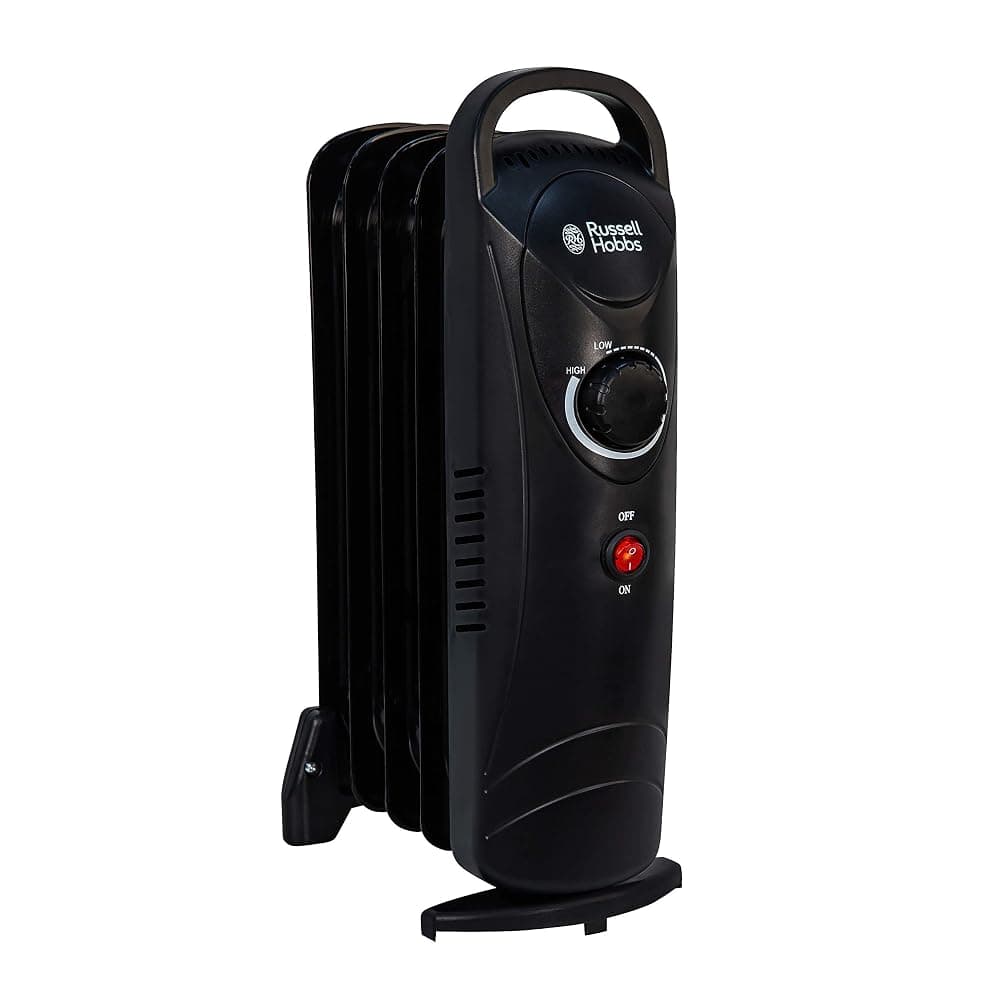
Russell Hobbs 650W 5-Fin Oil Filled Radiator with Adjustable Thermostat, Black (RHOFR3001)
Best for: Heating one small room for hours at the lowest hourly cost.
At 650W, this Russell Hobbs oil-filled radiator draws about a third of the power of a 2kW heater: roughly 21c an hour flat out at our example rate, or about 83c for a four-hour evening. Russell Hobbs rates it for rooms up to 10m², a good match for a box room, a student bedroom or a home-office corner where a 2kW heater would be overkill. It is slow to warm up, then gives silent, steady heat, with a thermostat dial to stop it overshooting. It has one power level and no timer, and it will not heat a big, draughty living room in January.
Pros
- About 21c an hour at full power
- Silent, so it suits bedrooms and video calls
- Light enough (2.8kg) to move from room to room
Cons
- Too small for most living rooms
- One power setting and no timer
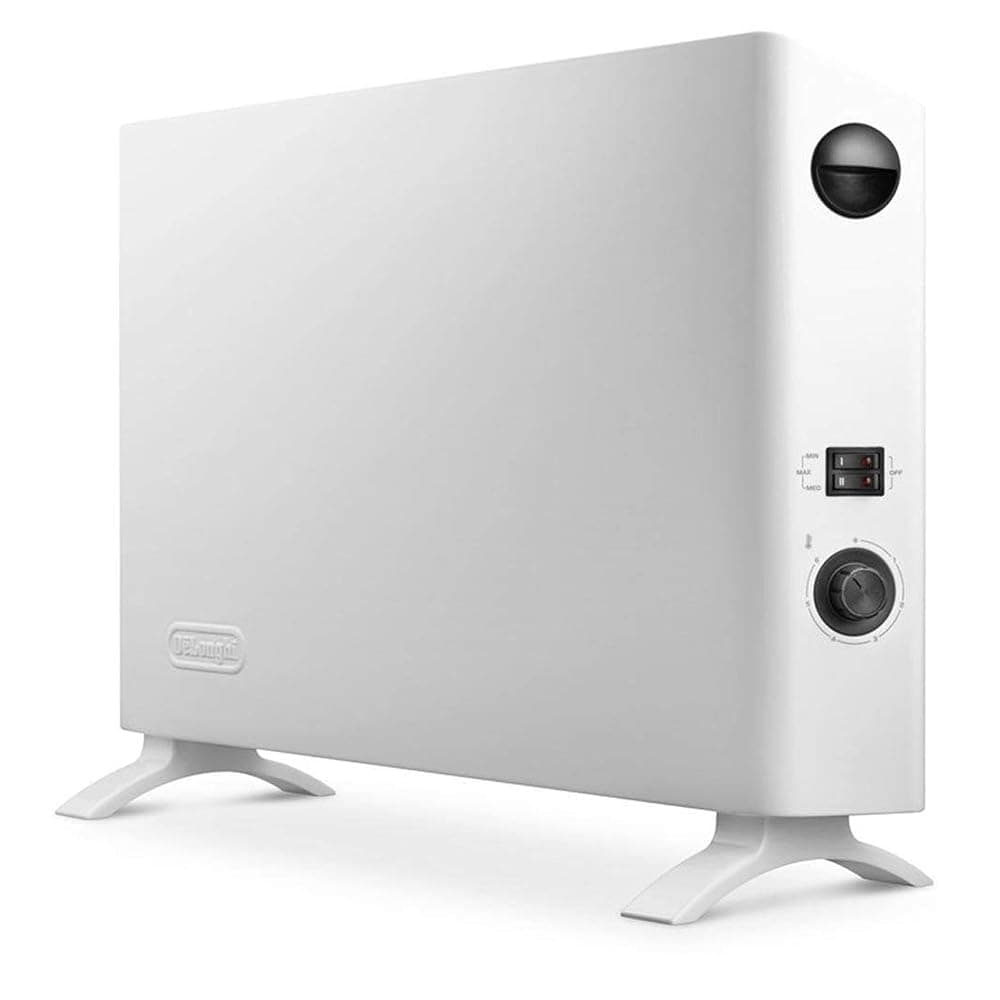
De'Longhi HSX2320 2kW Slim Convector Heater with Thermostat and Anti-Frost Setting, White
Best for: Rooms that need warming quickly, then holding on a low setting.
The De’Longhi HSX2320 earns its place with three power settings: 800W (about 26c an hour), 1,200W (about 38c) and 2,000W (about 64c). Warm a cold room on full power for half an hour, then drop to 800W and let the thermostat hold it, and a four-hour evening costs roughly half what it would flat out. Its anti-frost mode switches it on below 5°C, handy in a utility room or holiday home, but it will run whenever the room is that cold. It is only 9cm deep and weighs 4kg. There is no timer, and De’Longhi pitches it for occasional and spot heating rather than all-day use.
Pros
- Three settings from 800W to 2,000W
- Thermostat and anti-frost protection
- Slim 9cm depth sits flat against a wall
Cons
- No timer or smart controls
- Heat fades quickly once it cycles off
Dehumidifiers: cheap to run, even for long hours
| Dehumidifier | Power | Per hour | Per day (8 hours) | Per week (56 hours) |
|---|---|---|---|---|
| Compressor (MeacoDry Arete One 20L, rated) | About 216W | About 7c | About 55c | About €3.87 |
| Desiccant, low setting | About 330W | About 11c | About 84c | About €5.91 |
| Desiccant, high setting | About 650W | About 21c | About €1.66 | About €11.65 |
Damp air feels colder and feeds condensation and mould, and a compressor dehumidifier draws a small fraction of a heater’s power. Even around the clock at full power, a 216W model would use about 5.2kWh a day, about €1.66, and the humidistat cuts that well down once the room is dry; a night rate cuts it further. Desiccant models use more power but work better in a cold garage or holiday home and give off a little warmth. Our dehumidifier guide explains how to size one.
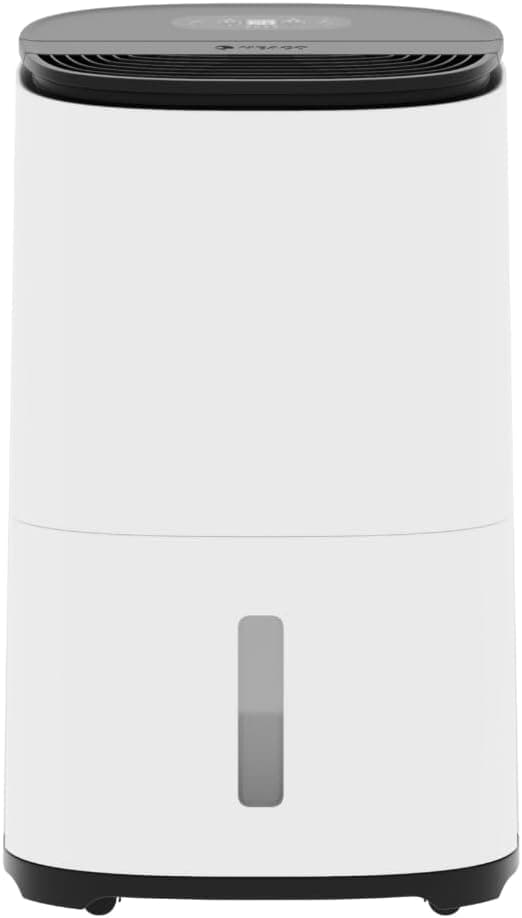
Meaco Arete One 20L Dehumidifier and Medical-Grade H13 HEPA Air Purifier (Low Energy)
Best for: Homes with condensation or damp, and anyone drying laundry indoors.
The MeacoDry Arete One 20L is a compressor dehumidifier with a rated draw of around 216W, about 7c an hour at our example rate, and it earns its keep twice over in winter. It pulls moisture out of the air to tackle condensation, and its laundry mode runs it continuously beside a clothes horse to dry a wash for far less than a conventional tumble dryer. It removes up to 20 litres a day under test conditions, adds an H13 HEPA filter, and Meaco quotes around 40dB in its quietest setting. It costs more to buy than basic models and, like any compressor unit, is less effective in a cold, unheated room.
Pros
- About 7c an hour at its rated power
- Laundry mode for drying clothes indoors
- H13 HEPA filter as well as dehumidifying
Cons
- Dearer to buy than basic dehumidifiers
- Less effective than a desiccant in a cold room
Electric blankets: warm the bed, not the room
| Use | Power | Per use | Per week (7 nights) |
|---|---|---|---|
| Pre-heat a single for 30 minutes | 60W | About 1c | About 7c |
| Pre-heat a dual-control double for 30 minutes | 120W | About 2c | About 13c |
| Heated throw on the sofa for a 3-hour evening | 150W | About 14c | About €1.01 |
| All night (8 hours), all-night models only | 120W | About 31c | About €2.15 |
| For comparison: a 2kW bedroom heater for an hour before bed | 2,000W | About 64c | About €4.48 |
Pre-heating the bed and turning the bedroom heater off or down is one of the easiest savings of the winter. Only leave a blanket on overnight if it is designed for all-night use, and replace one that is around ten years old or shows scorch marks or worn fabric; our electric blanket guide covers sizes and safety. When we checked, the electric blankets Amazon.ie sold itself were mostly European models with two-pin plugs, so check the plug and the “Ships from and sold by” line before you buy.
Also worth considering
Links open an Amazon.ie search filtered to items sold & dispatched by Amazon.ie. Availability changes.
- Search Amazon.ie
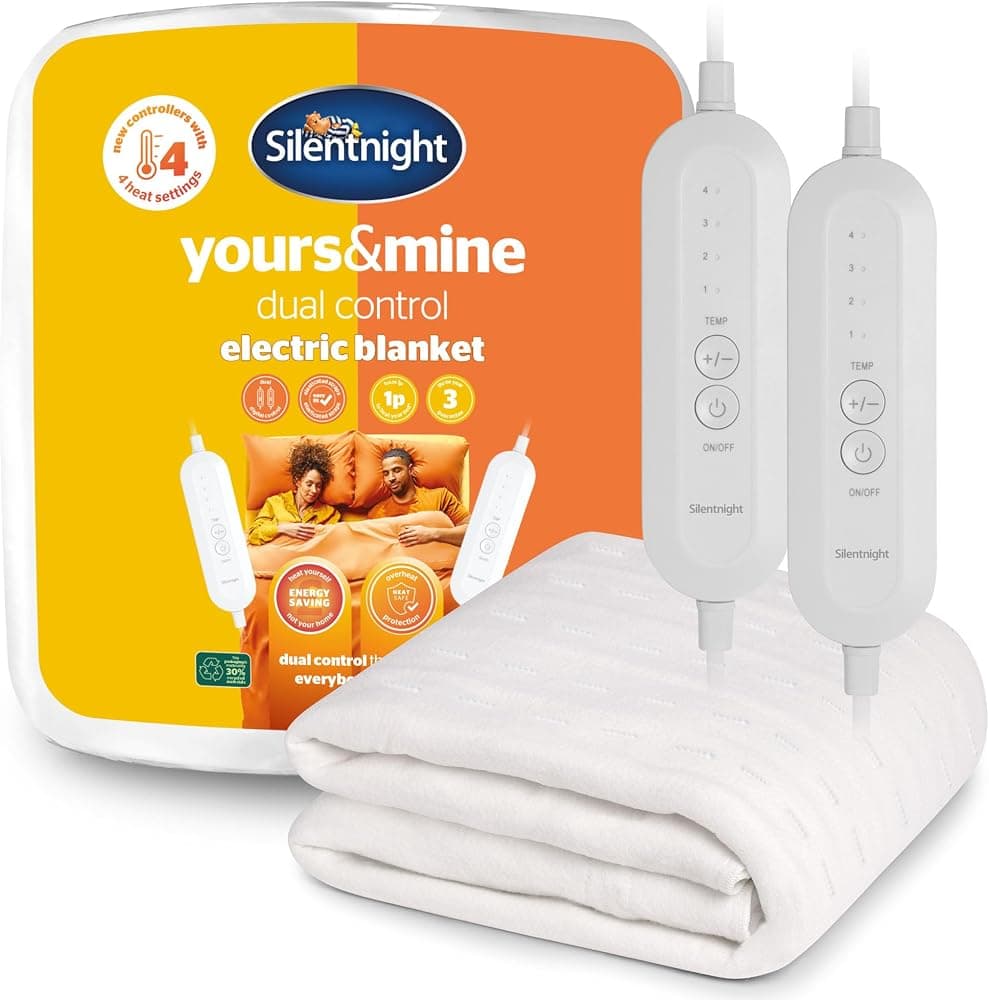
Silentnight Dual Control electric blanket
Separate controls for each side, so one person can pre-heat their half without paying to heat the other. Silentnight also makes heated throws for the sofa. Check the size, wattage and that the plug is the UK/Irish 3-pin type.
Cooking: air fryer vs oven, and the kettle
| Appliance | Power | Time | Energy | Per meal | Per week (4 meals) |
|---|---|---|---|---|---|
| Air fryer (typical single basket) | 1,750W | 3 min preheat + 20 min | About 0.67kWh | About 21c | About 86c |
| Electric fan oven | 2,500W | 12 min preheat + 30 min | About 1.75kWh | About 56c | About €2.24 |
| Microwave, reheating a portion | About 1,200W drawn | 5 min | About 0.1kWh | About 3c | About 13c |
An air fryer heats a small basket instead of a full-size oven and barely needs preheating, so it uses roughly a third of the oven’s energy for a weeknight portion: up to about €70 a year saved if you cook that way four times a week. The gap closes if you cook in two batches, and a roast for six still belongs in the oven. A microwave’s name gives its cooking power (800W, say); it draws more from the socket, so check the rating plate. See our air fryer guide for sizes and our kettle and toaster guide for quiet boil kettles.
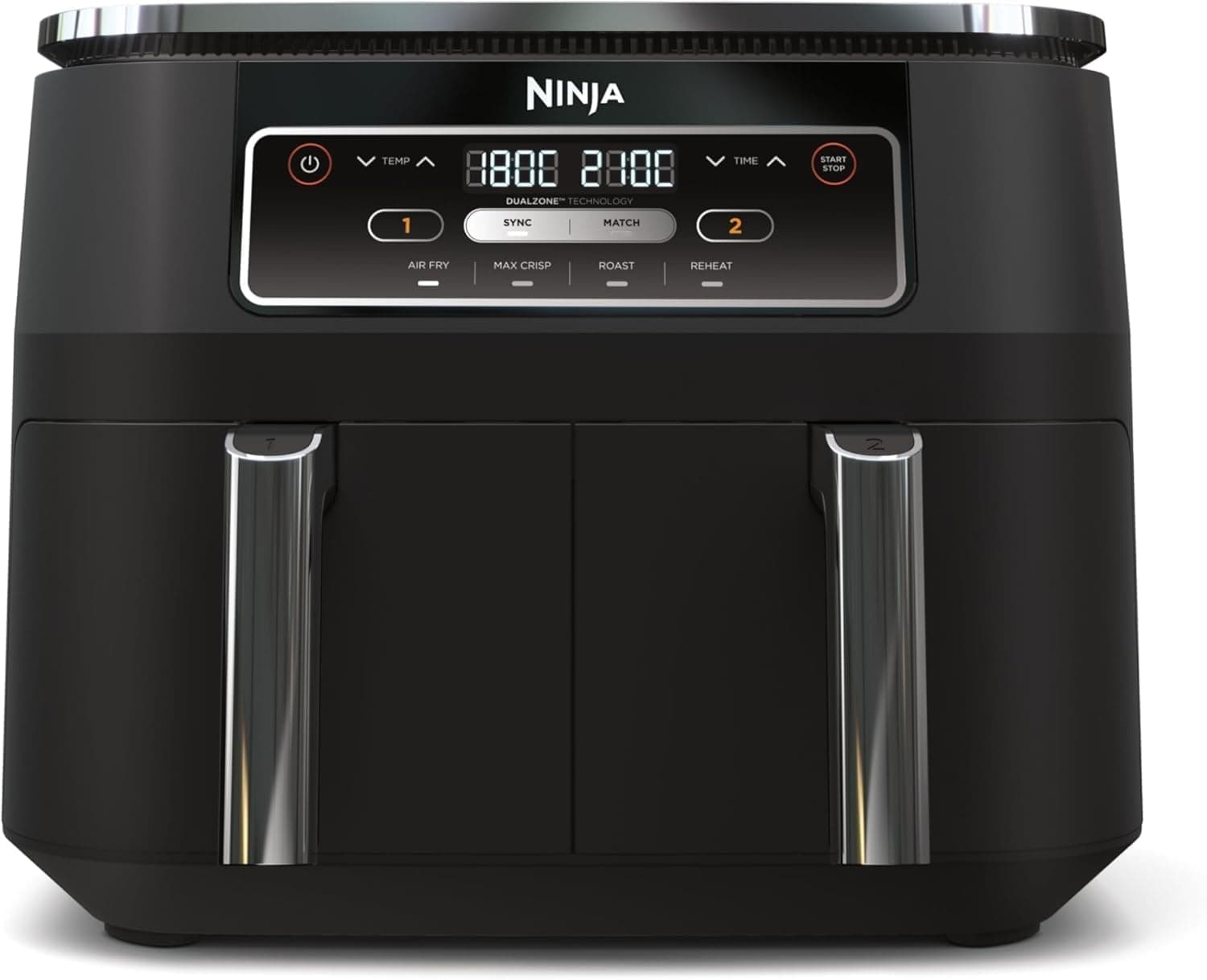
Ninja Foodi Dual Zone Digital Air Fryer 7.6L – 2 Drawers, 4-in-1, Black (AF200UK)
Best for: Families of three or four who use the oven most weeknights.
Amazon.ie price as of 26 Oct 2026, 06:46. May have changed.
Ninja’s AF200UK has two independent 3.8-litre drawers, each with its own time and temperature, timed to finish together. That makes it a real oven replacement on weeknights: chicken in one drawer and chips or roast veg in the other, with no need to heat the oven for the side. Ninja says each drawer takes up to 1kg of fries or a 1.6kg chicken, and running one drawer uses less power than running both, so use a single drawer for small portions. It has four functions (Max Crisp, Air Fry, Roast and Reheat) and dishwasher-safe drawers. Measure your worktop first: it is 38cm wide and weighs 8.2kg.
Pros
- Cooks a main and a side together without the oven
- One drawer for small portions
- Dishwasher-safe drawers and crisper plates
Cons
- Takes up 38cm of worktop and weighs 8.2kg
- No Bake or Dehydrate functions (those are on the AF300UK)
| What you boil | Energy | Cost |
|---|---|---|
| One mug (250ml) | About 0.03kWh | About 1c |
| A full kettle (1.7 litres) | About 0.21kWh | About 7c |
| A full kettle four times a day, for a week | About 5.9kWh | About €1.88 |
| Two mugs’ worth (about 0.5 litres) four times a day, for a week | About 1.8kWh | About 58c |
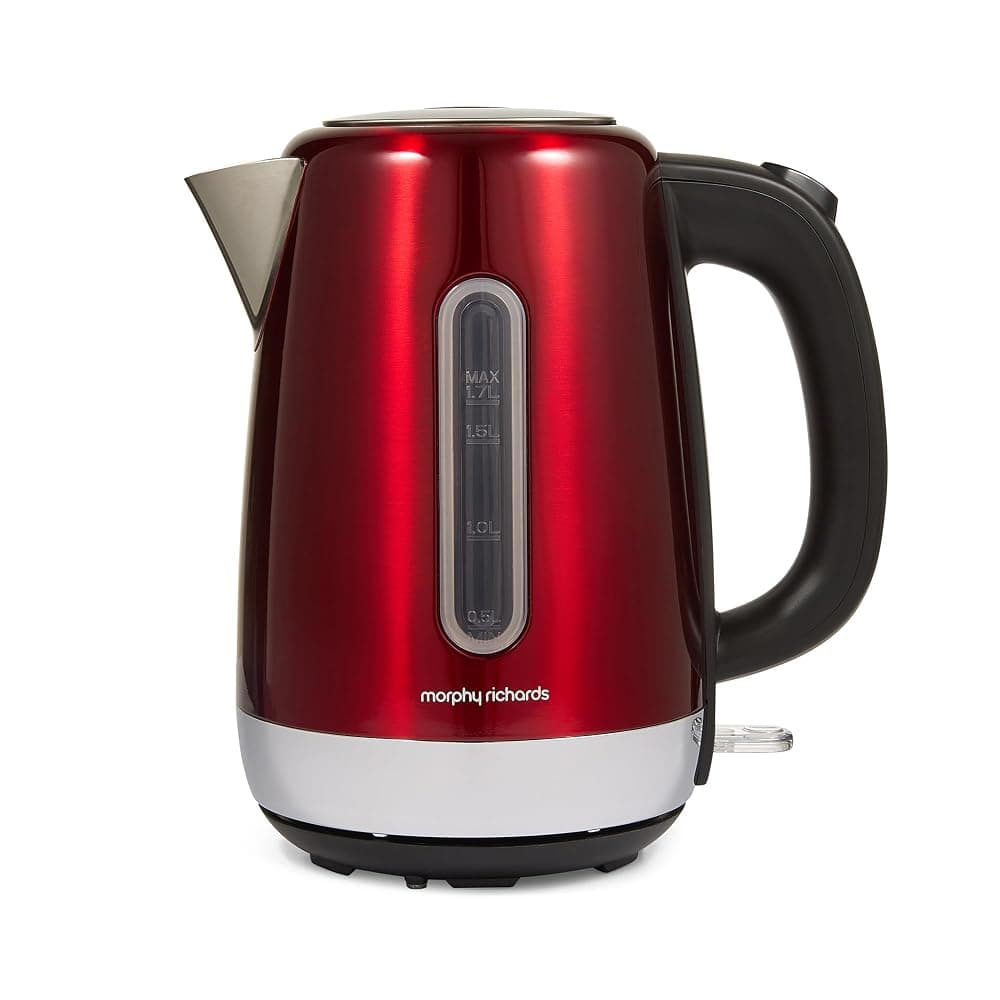
Morphy Richards Equip 1.7L Jug Kettle, 3kW Rapid Boil, Removable Limescale Filter, Easy View Water Gauge, Red (102785)
Best for: Replacing an old kettle, if you are buying one anyway.
A 3kW kettle uses almost the same energy per litre as a 2.2kW one; it just boils sooner. The saving is in the filling: if you usually boil a full jug four times a day, switching to two mugs’ worth saves about €1.30 a week, or up to around €70 a year. You do not need a new kettle for that (fill it with the mug you are about to use), but if yours is due for replacement, a plain one with a visible gauge makes the habit easier. The Morphy Richards Equip has what Morphy Richards calls an easy-view water gauge, a 3kW element, a removable limescale filter for hard-water areas and a 360° base. Some owners find small amounts hard to judge through the gauge, so measure with a mug until you know the markings, and never fill below the minimum line. It is a plain kettle with no temperature settings or keep-warm function, and noise is a common complaint in owner feedback; if you want a quieter kettle, see the quiet boil models in our kettle guide. The listing does not state the plug type, but 102785 is the UK model number. This link is the red version; other colours on the same listing may come from other sellers, so check the seller for the one you pick.
Pros
- Water gauge to help you boil only what you need
- Removable limescale filter for hard water
- Sold and dispatched by Amazon.ie when we checked
Cons
- Noise is a common complaint from owners
- Some owners find small amounts hard to read in the gauge
- No quiet boil or temperature control
Drying clothes: tumble dryer vs heated airer vs dehumidifier
| Method | Typical power | Time per load | Energy per load | Cost per load | Per week (4 loads) |
|---|---|---|---|---|---|
| Conventional vented or condenser tumble dryer | 2–3kW while heating | 1.5–2.5 hours | About 3.5–5kWh | About €1.12–€1.60 | About €4.48–€6.40 |
| Heat-pump tumble dryer | Usually under 1kW | 2–4 hours | About 1.5–2.5kWh | About 48–80c | About €1.92–€3.20 |
| Compressor dehumidifier and clothes horse, small closed room | About 216W (Arete One, rated) | 6–8 hours | About 1.3–1.7kWh | About 41–55c | About €1.66–€2.21 |
| Heated airer on its own | About 150–300W | 6–8 hours | About 0.9–2.4kWh | About 29–77c | About €1.15–€3.07 |
| Clothes horse on its own | None | A day or more | None | Nothing directly | Nothing, but it adds damp to the house |
A dehumidifier beside an ordinary clothes horse, in a small room with the door closed, is one of the cheapest ways to dry a wash indoors, and it takes the moisture out of the air instead of leaving it on your windows. A heated airer is cheap to run but only speeds up evaporation into the room, so pair it with a dehumidifier and the airer’s cover if you can. Whatever you use, pick the fastest spin the fabric allows: water spun out in the drum does not have to be dried out with electricity. Never dry clothes on or over an electric heater. For the full method, see our guide to drying clothes indoors in Ireland.
Also worth considering
Links open an Amazon.ie search filtered to items sold & dispatched by Amazon.ie. Availability changes.
- Search Amazon.ie
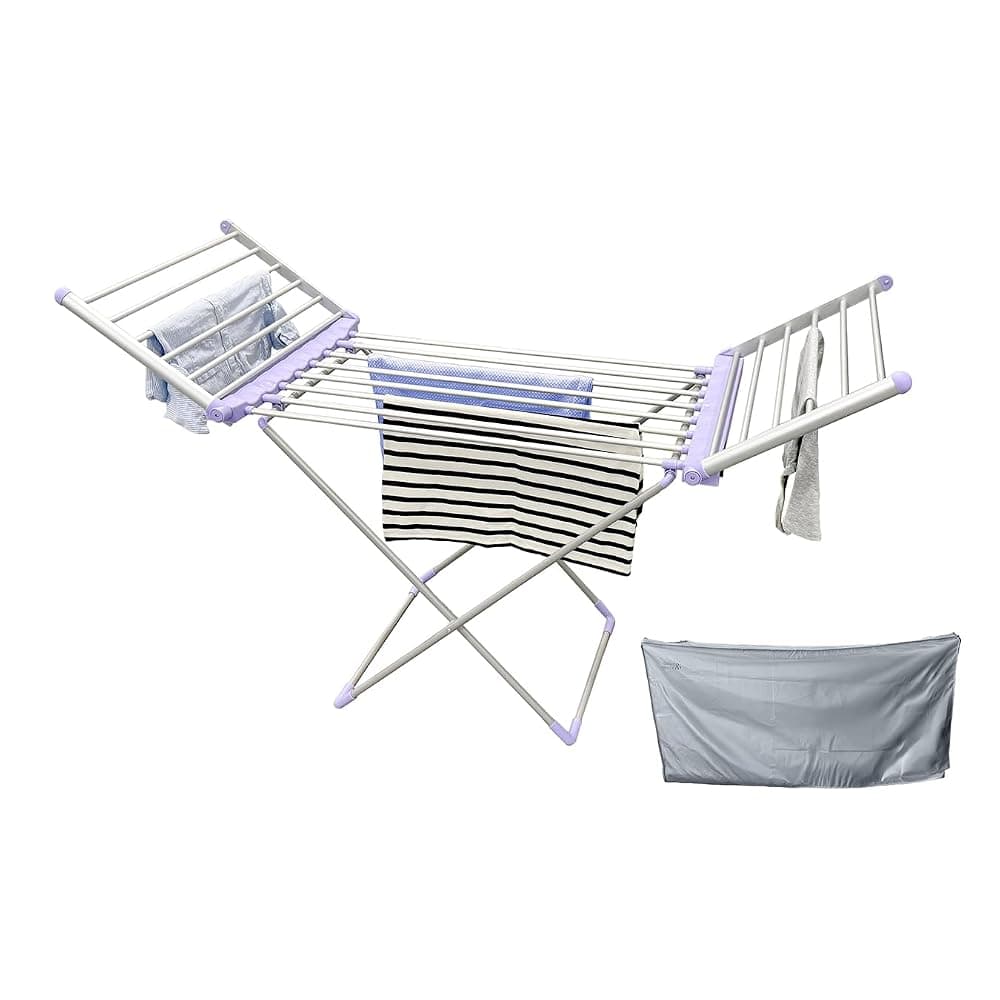
Spring & Spruce Speedi-Dry winged heated airer (3-tier)
A three-tier winged heated airer that showed up in Amazon.ie’s own stock when we checked. Check the wattage (it sets the running cost), that the plug is the UK/Irish 3-pin type and that the seller line says Amazon.ie.
What winter habits add up to
| Habit | Energy over the winter | Cost over the winter |
|---|---|---|
| 2kW heater, 4 hours every evening, thermostat on 60% of the time | About 672kWh | About €215 |
| 650W oil-filled radiator, 4 hours every evening | About 364kWh | About €116 |
| Conventional tumble dryer, 4 loads a week at about 4.5kWh each | About 360kWh | About €115 |
| Compressor dehumidifier, 8 hours a day at its rated 216W | About 242kWh | About €77 |
| Dehumidifier drying 4 loads a week, 7 hours each | About 121kWh | About €39 |
| Oven instead of an air fryer, 4 weeknight meals a week (extra cost) | About 86kWh | About €28 |
| Full kettle instead of two mugs’ worth, 4 times a day (extra cost) | About 81kWh | About €26 |
| Electric blanket pre-heating a double for 30 minutes a night | About 8kWh | About €3 |
| Immersion heater (typically about 3kW), 1 hour a day | About 420kWh | About €134 |
| Electric shower (often 8.5–10.5kW), 10 minutes a day at 9.5kW | About 222kWh | About €71 |
Common mistakes that add to the bill
- Treating the wattage as what it always uses, or ignoring the hours. The rating is the maximum, but a 216W dehumidifier running all day still uses more than a 2kW heater on for half an hour.
- Believing one heater type is “more efficient”. Every plug-in electric heater turns about 100% of its electricity into heat. Pay for controls (power settings, thermostat, timer), not miracle claims.
- Heating at peak on a smart plan. Warming a room before 5pm, or waiting until after 7pm, can cost noticeably less for the same comfort.
- Running heaters or dryers from an extension lead. A 2–3kW heater can use most or all of a 13A lead’s capacity on its own, and many leads are rated lower, so plug it straight into the wall.
- Switching a heater remotely with a plug-in timer or smart plug. Many heater manuals warn against it; use the heater’s own timer.
- Buying a heater with an EU two-pin plug. Running a high-wattage appliance through a travel adaptor for hours is a fire risk. Some items sold by Amazon.ie itself are EU versions, so check the plug even on Amazon.ie stock; every mains product in our catalog is a UK-market version with the 3-pin plug.
Cheaper-to-run choices: the short version
Small room: a low-wattage oil-filled radiator. Bigger room: a heater with low settings and a thermostat. Cold bedroom: an electric blanket instead of a heater. Damp and laundry: a compressor dehumidifier. Dinners: an air fryer instead of the oven. Tea: a kettle with a clear gauge, filled only as far as you need.
Russell Hobbs 650W 5-Fin Oil Filled Radiator with Adjustable Thermostat, Black (RHOFR3001)
See today's price on Amazon.ie.
Check price on Amazon.ieDe'Longhi HSX2320 2kW Slim Convector Heater with Thermostat and Anti-Frost Setting, White
See today's price on Amazon.ie.
Check price on Amazon.ieMeaco Arete One 20L Dehumidifier and Medical-Grade H13 HEPA Air Purifier (Low Energy)
See today's price on Amazon.ie.
Check price on Amazon.ieNinja Foodi Dual Zone Digital Air Fryer 7.6L – 2 Drawers, 4-in-1, Black (AF200UK)
Amazon.ie price as of 26 Oct 2026, 06:46. May have changed.
Morphy Richards Equip 1.7L Jug Kettle, 3kW Rapid Boil, Removable Limescale Filter, Easy View Water Gauge, Red (102785)
See today's price on Amazon.ie.
Check price on Amazon.ieEach catalog product here was sold and dispatched by Amazon.ie when it was last checked, and each is a UK-market version with the Irish/UK 3-pin plug, so there are no UK import charges and EU consumer rights apply. Heaters and dehumidifiers are often discounted around Black Friday, but if a room is cold or damp now, waiting weeks for a deal rarely pays. For more, see our winter home essentials guide, all our home guides or the Home & Kitchen category.