The short answer
The cheapest reliable way to dry clothes indoors in Ireland is to spin the wash hard, spread it out on an airer in a small room, close the door and window, and run a compressor dehumidifier beside it, ideally overnight on a cheaper night rate. A heated airer with a cover speeds things up for a few cent an hour, but it should be paired with a dehumidifier or good ventilation, because it pushes the water into the air faster. A heat-pump tumble dryer is the low-effort option with modest running costs if you have the space and budget; a vented or condenser dryer is quicker still but costs the most per load.
What you should not do is drape wet washing over radiators in a closed bedroom and hope for the best. That is how a lot of Irish houses end up with streaming windows, black spots in the corners of the ceiling and towels that smell musty even when they are dry. And not every winter day is a washout: a dry, breezy day does most of the work on the line even when it is cold, and finishing a half-dry load indoors puts far less water into the house.
Why drying indoors causes condensation and mould
A spun wash is still wet: a typical load holds around two litres of water, and more for a full drum of towels, bedding or jeans, or a low spin speed. Every drop of that has to evaporate into the room. Warm air holds that moisture until it meets something cold, such as a single-glazed window, an uninsulated external wall or the back of a wardrobe pushed against one, and there it turns back into water. Do that most days through an Irish winter, on top of showers, cooking and breathing, and the coldest corners stay damp long enough for mould to take hold.
The number to watch is relative humidity. Irish building guidance on condensation flags prolonged humidity above about 70% as the point where mould on cold surfaces becomes likely, and keeping rooms somewhere around 40–60% is a sensible target. A cheap hygrometer in the drying room and the coldest bedroom shows you what is actually happening, rather than waiting for the windows to tell you.
The Dublin Drop — Friday Deals
Price drops on Amazon.ie stock, once a week. No customs fees, no spam.
Free. No spam. Unsubscribe anytime. We only send verified domestic deals.
What you need: four ways to set up
You do not need all of the kit in the quick picks above. Pick the set-up that fits your home, how much washing you do, and how much you want to spend up front. Upfront costs are typical Amazon.ie price bands when we checked and move often; running costs are worked out in the running costs section below. If you are starting from scratch and dry washing indoors most days from October to March, the dehumidifier is the piece to spend on; our dehumidifier guide covers sizing and models in more depth.
| Set-up | Kit | Typical upfront cost | Speed | Damp risk |
|---|---|---|---|---|
| Airer and ventilation | Clothes horse, open window or extractor fan | Under €60 | Slow (often a day or more in winter) | Medium to high, and you lose heat |
| Airer and dehumidifier (our recommendation) | Clothes horse plus a compressor dehumidifier | About €200–€350 for both | Often overnight in a small closed room | Low: the water goes into the tank |
| Heated airer and dehumidifier | Heated airer with cover plus a dehumidifier | About €250–€450 for both | Faster, often a few hours under a cover | Low, if the dehumidifier keeps up |
| Tumble dryer | Heat-pump, condenser or vented dryer | Usually a few hundred euro and up | Fastest: roughly 1.5–3 hours a load, with heat-pump models at the longer end | Low for heat pump and condenser (a vented dryer needs a vent outside) |
Step by step: the dehumidifier and airer method
- Spin as fast as the care label allows. Every bit of water the machine spins out is water you do not have to evaporate. Use the highest spin the fabric can take (see spin speeds below), and give towels and jeans an extra spin cycle if they come out heavy.
- Pick the smallest room you can close off. A box room, utility room or spare bedroom works well. Avoid the room someone sleeps in, and avoid the hot press: an airing cupboard is for airing clothes that are already dry, and putting wet washing in a closed press just moves the damp in beside your bedding.
- Shake each item out and leave gaps. Hang things single-layer with space between them so air can move through. Turn hoods, pockets and thick seams out, hang shirts on hangers, and lay jumpers flat. An overloaded airer is the most common reason washing stays damp.
- Put the dehumidifier close to the airer. Set it about half a metre to a metre away, with the air outlet pointing across the clothes, and leave clearance around the intake (check the manual for the exact distance). Switch on laundry mode if it has one, or run it continuously on a high fan setting.
- Close the door and the window. A dehumidifier dries the air in the room it is in. Leave the window open and it spends the night trying to dry the weather outside; leave the door open and it is drying the whole house slowly instead of the washing quickly.
- Run it overnight, on a night rate if you have one. If you are on a day/night or smart time-of-use tariff, the cheaper night hours are the time to run it. In a small room a load is often dry or close to it by morning, but bulky cottons take longer.
- Check the hygrometer and the tank. The drying room will read high while the clothes are wet and should fall as they dry. Empty the tank in the morning (or set up continuous drainage into a sink if the unit and room allow), and turn the heaviest items before work if they still feel damp.
- Finish and fold. Bring things in once they are fully dry: folding slightly damp clothes into a drawer is how musty smells start.
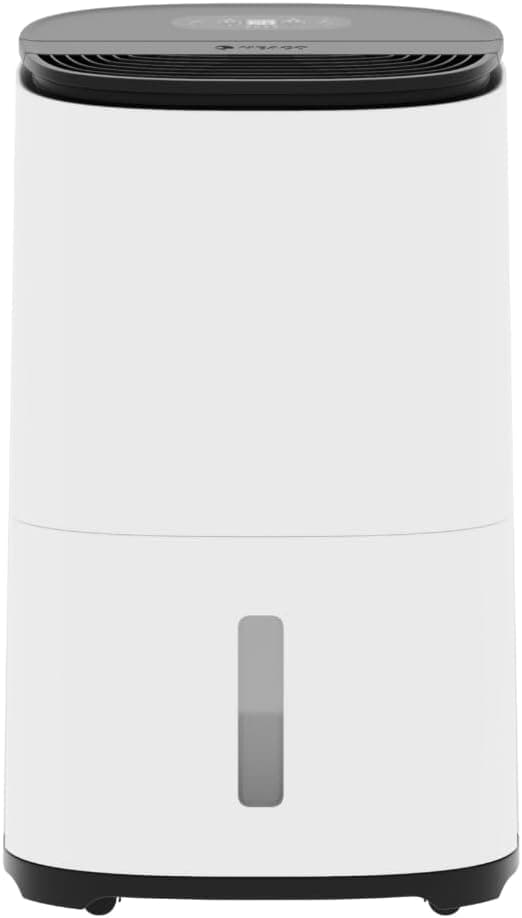
Meaco Arete One 20L Dehumidifier and Medical-Grade H13 HEPA Air Purifier (Low Energy)
Best for: Heated homes that dry most of their laundry indoors from autumn to spring.
The Arete One 20L is a compressor dehumidifier with a dedicated laundry mode and a built-in H13 HEPA filter, and it is sized for a family home that dries washing indoors most days. Meaco quotes a rated draw of around 216 W, which is a fraction of a conventional tumble dryer, and around 40 dB in its quietest setting. Outside laundry time, the humidistat lets it run as an everyday condensation fighter, so the same appliance keeps the bedroom windows clear. Like any compressor unit it loses effectiveness in a cold room, so it suits a heated house better than an unheated back room or garage (see cold rooms below). It is also a heavy unit to carry up and down the stairs every day, so give it a permanent home in the drying room if you can.
Pros
- Laundry mode dries a load at a low running cost
- Doubles as an everyday condensation fighter
- H13 HEPA filter adds air filtering
Cons
- Less effective in unheated rooms below about 15°C
- Heavy to carry between floors
- Replacement filters are an ongoing cost
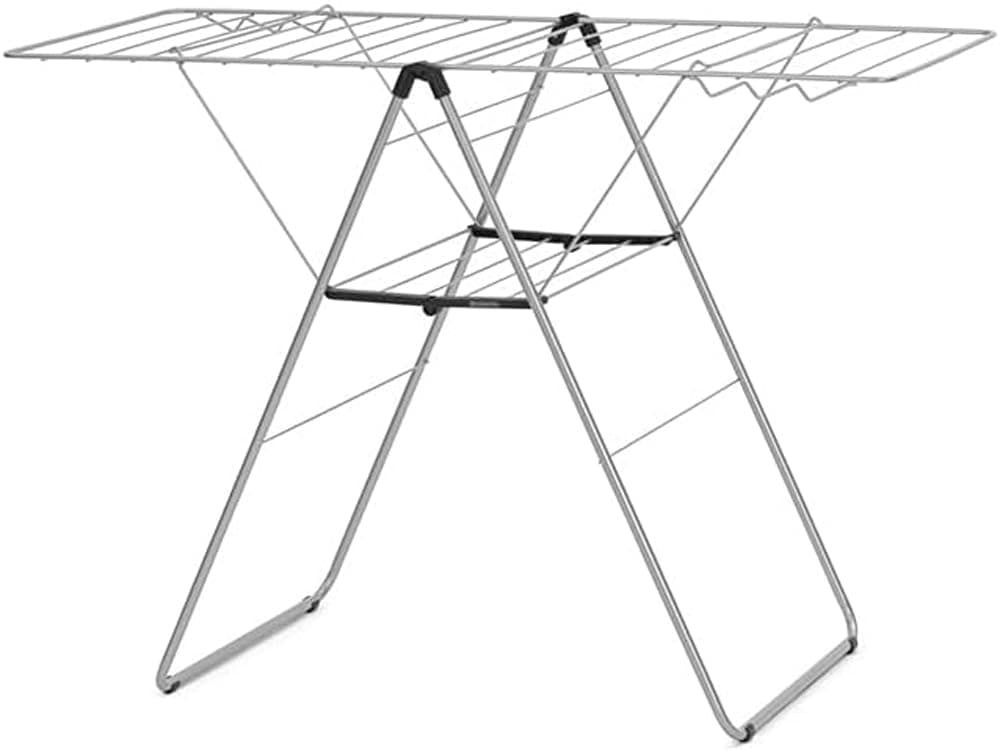
Brabantia HangOn Laundry Drying Rack, 20m (Metallic Grey) – Foldaway Stainless Steel Clothes Horse with Drying Platform
Best for: Families pairing an airer with a dehumidifier in a spare room or utility.
Brabantia’s HangOn is a stainless steel clothes horse with 20 metres of line, which Brabantia says takes up to two machine loads. The wings adjust in height so sheets and trousers hang clear of the floor, six hooks take shirts on hangers, and a flat platform suits woollens. A transport lock lets you move it loaded, and it folds to about 5cm deep. It is about 126cm wide in use, so measure a box room before you buy; if floor space is tight, the Beldray tower below suits better. A bigger 25m HangOn (about 180cm wide in use, by Brabantia’s figures) suits very large loads.
Pros
- Plenty of line to hang a load single-layer
- Hanger hooks and a flat drying platform
- Transport lock for moving it loaded
Cons
- Wide footprint for a small room
- Costs more than a basic clothes horse
- Not heated
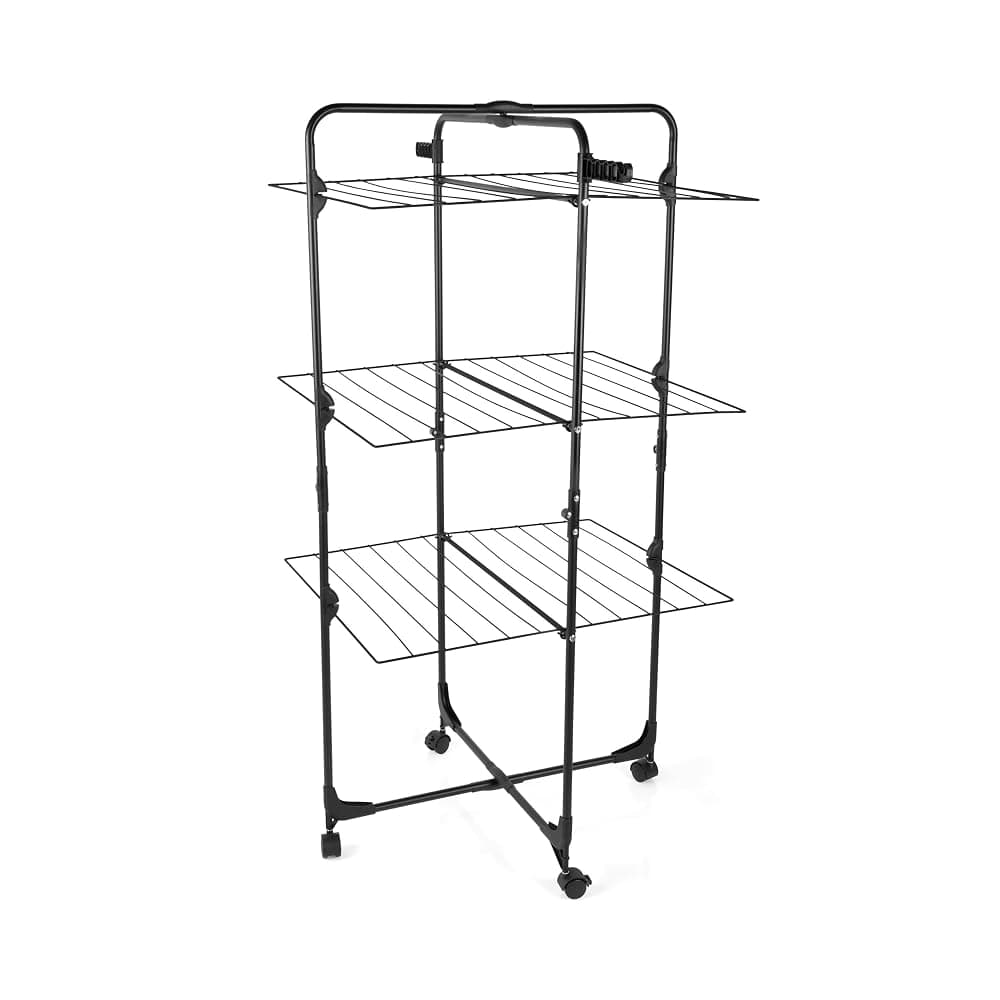
Beldray 30 Metre 3-Tier Tower Airer – Foldable Carbon Steel Clothes Drying Rack with Locking Wheels and 10 Hanger Holes (White)
Best for: Small rooms, apartments and large families short on floor space.
A tower airer is the answer for apartments and box rooms. This Beldray model stacks 30 metres of line over three tiers in a footprint of about 69 x 62.5cm, rolls on locking wheels and has 10 hanger holes. The trade-off is airflow: the lower tiers are boxed in by the ones above and dry more slowly, so put the heaviest items on top or nearest the dehumidifier and leave gaps. It is carbon steel and unheated, and it is one of the cheaper ways to add a lot of drying space. Stock was running low when we checked, so check availability before you plan around it.
Pros
- Lots of line in a small footprint
- Locking wheels to move between rooms
- Budget price band
Cons
- Lower tiers dry more slowly
- No flat drying platform for knitwear
- Carbon steel rather than stainless
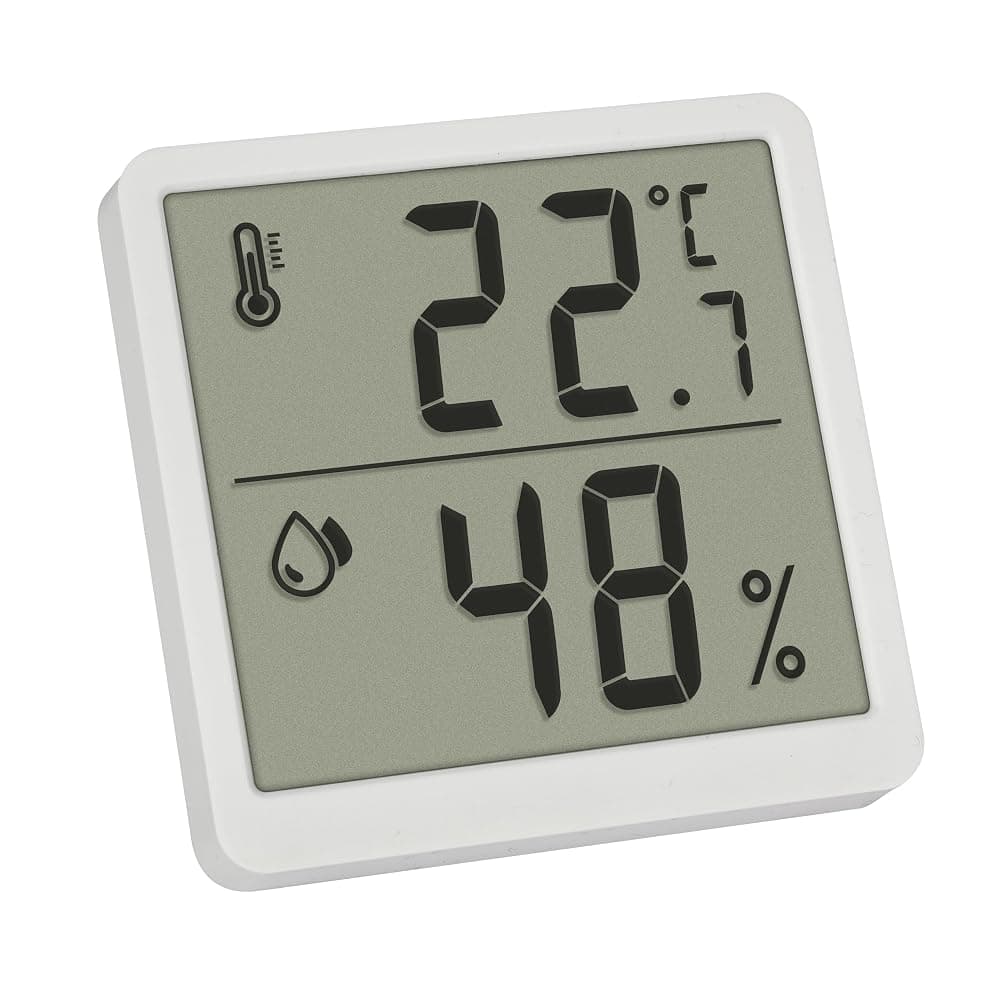
TFA Dostmann Digital Indoor Thermo-Hygrometer 30.5059.02 – Room Temperature and Humidity Meter with Stand and Magnet (White)
Best for: Anyone who wants to know whether their drying set-up is keeping damp down.
A hygrometer turns guesswork into a number. This TFA Dostmann unit shows temperature and relative humidity (20–95%), stands on a shelf or sticks to a metal surface, and comes with its battery. Put it in the drying room to see the humidity fall as the clothes dry, then move it to the coldest bedroom to check that the rest of the house is staying around 40–60%. Like any budget hygrometer, treat the reading as a guide: it can be a few percent out, and some owner feedback mentions units reading noticeably high or low.
Pros
- Low cost, small and battery powered
- Stand and magnetic back
- Shows temperature as well as humidity
Cons
- Approximate readings, like most budget meters
- No history or phone alerts
- Instructions may not include English
Spin speeds: the free first step
The washing machine is the cheapest dryer you own. Moving from a 1,000rpm spin to 1,400rpm leaves noticeably less water in a load of cottons, which means less to evaporate, less condensation and a shorter run for the dehumidifier or tumble dryer. The few extra minutes of spinning cost very little compared with drying that water out afterwards.
- Cottons, towels, bedding and jeans: use the highest spin the care label allows, often 1,200–1,600rpm depending on your machine. An extra spin-only cycle helps with heavy towels.
- Synthetics and sportswear: a medium spin, often around 800–1,000rpm, is usually enough, and these dry quickly anyway.
- Wool, silk and delicates: follow the label. A low spin or the wool programme, then dry flat on an airer platform rather than hanging.
- Buying a washing machine? The EU energy label shows a spin-drying efficiency class from A to G; A leaves the least water in the load. If you dry indoors a lot, it is worth weighing alongside the energy class.
- Do not overfill the drum. An overloaded drum washes and rinses less effectively, and the washing can come out wetter and more creased.
Cold rooms: compressor or desiccant dehumidifier?
This is where a lot of people get caught. A compressor dehumidifier, like the Meaco Arete One, works by chilling a coil so water condenses on it. It is very efficient in a heated room, but as the room gets colder it removes less water and spends more time defrosting its coil. If your drying room is an unheated back bedroom, a utility room off a cold extension, a garage or a mobile home, a desiccant dehumidifier is usually the better tool: it absorbs moisture onto a wheel and drives it off with a heater, so it keeps working in the cold and can warm a small room by a few degrees, which helps the washing dry. The cost is a higher power draw, so in a heated house a compressor model is cheaper to run for the water it removes; a desiccant earns its place when the only drying space is cold and heating it would cost more.
| Compressor | Desiccant | |
|---|---|---|
| Best room temperature | Heated rooms, roughly 15°C and up | Cold rooms, garages, holiday homes |
| Typical power draw | Around 150–250 W | Around 300–650 W, depending on setting |
| Effect on the room | Slight warming | Noticeable warming, which helps laundry |
| Noise | Compressor hum | Fan noise only |
| Weight | Heavier | Lighter, easier to carry |
| Best for | Heated homes, everyday condensation and laundry | Laundry in an unheated room |
Desiccant dehumidifiers to look for
Links open an Amazon.ie search filtered to items sold & dispatched by Amazon.ie. Availability changes.
- Search Amazon.ie
Meaco DD8L Zambezi
A well-known desiccant model for cold rooms and garages, with a lower rated capacity than a 20-litre compressor unit and a higher draw on its top setting. When we checked, we could not find a mains desiccant unit sold by Amazon.ie itself, so this search may come up empty. If you buy elsewhere, check the seller line and that it has a UK/Irish 3-pin plug; here is why we only list Amazon.ie stock.
Heated airers: with a cover or without?
A heated airer is a clothes horse with warm bars, usually drawing somewhere around 100–300 W (check the listing for the exact figure). Without a cover it dries the items touching the bars reasonably well, but much of the heat drifts off into the room, so a full load still takes a long time. With a fitted cover, it becomes a small warm tent: the heat stays around the clothes and drying is much faster. The thing to understand is that a heated airer does not remove any water; it only gets it into the air faster. Under a cover in a small closed room, that means more condensation, more quickly. The best combination is a heated airer and a dehumidifier in the same room, door closed: the airer speeds up evaporation and the dehumidifier collects it. If you do not have a dehumidifier, use the heated airer in a room with an extractor fan running or a window open, accepting some heat loss.
- Use only the cover made for it. Do not throw a duvet, towel or blanket over a heated airer to improvise one; that is not what it is designed for.
- Check the care labels. Some fabrics should not go on warm bars, and the manufacturer may list items to avoid.
- Keep it out of the bathroom. Plug-in appliances are not designed for wet areas. A bedroom, landing or utility room is the place for it.
- Plug it straight into a wall socket where you can, never into an extension lead plugged into another lead, and use the timer if it has one.
- Never dry clothes on or over a portable heater. See the safety notes in our electric heaters guide.
Heated airers to look at
Links open an Amazon.ie search filtered to items sold & dispatched by Amazon.ie. Availability changes.
- Search Amazon.ie
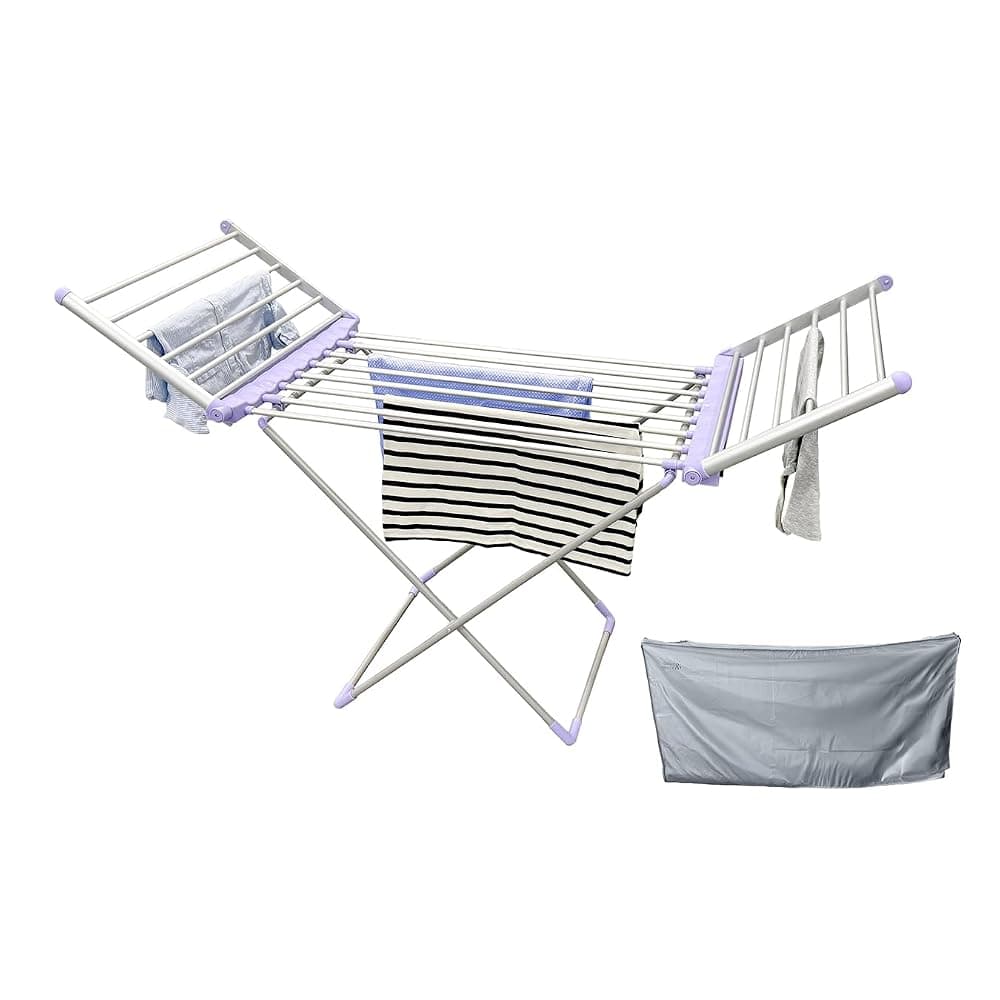
Spring & Spruce Speedi-Dry winged heated airer (3 tiers, with cover)
Sold by Amazon.ie when we checked, with low stock. The listing describes 36 heated bars adjustable from 30 to 70°C, a 1–9 hour timer, an insulating cover and folding to about 11cm wide. It does not state the plug type, so check that before you buy.
- Search Amazon.ie
Other heated airers with a cover
Compare wattage, tiers and whether a cover is included, and choose a UK/Irish 3-pin plug and an Amazon.ie seller line.
Tumble dryers: heat pump, condenser or vented?
- Vented dryers heat the air and push it outside through a hose, so they need a wall vent or a window. They are usually the cheapest to buy, but along with condenser models they use the most electricity per load, and a hose hanging out of an open window lets the warm, damp air straight back in.
- Condenser dryers also use a heating element, but they cool the damp air inside the machine and collect the water in a tank (or send it down a drain), so they can go anywhere. They use a similar amount of electricity to a vented dryer and give off some warmth and a little moisture into the room.
- Heat-pump dryers are a type of condenser dryer that recycles the heat instead of making it fresh each time. They typically use around half the electricity of a vented or condenser dryer per load, or less, and dry at lower temperatures, which is gentler on clothes. They cost more to buy, and cycles take longer.
A tumble dryer is still the quickest way to get a load fully dry, often in a couple of hours with a vented or condenser model, and the type matters more than the brand for running costs. Whichever you choose, the energy label shows the electricity used per cycle, which is the fairest comparison. Fire services advise against running a tumble dryer overnight or while you are out, so use cheaper evening hours while you are awake rather than the small hours. Clean the lint filter after every load, empty the water tank on a condenser or heat-pump model, and if the dryer will live in an unheated garage or shed, check the manufacturer’s minimum room temperature: heat-pump models in particular can struggle in the cold. Large appliances are bulky to deliver, so check the delivery and installation details on the listing, and whether removal of an old machine is offered.
Tumble dryers to search for
Links open an Amazon.ie search filtered to items sold & dispatched by Amazon.ie. Availability changes.
- Search Amazon.ie
Heat-pump tumble dryer
The lowest running cost per load. Compare the kWh per cycle on the energy label, the drum size (8–9kg suits most families) and the seller line before you buy. A condenser model costs less up front and suits occasional use.
No dehumidifier? Ventilate properly
If you are drying on a clothes horse alone, ventilation is what keeps the water from ending up on the walls. Cold outside air holds very little moisture even on a damp day, so when it comes in and warms up it can take on water from the washing, which is why opening a window works even in wet weather. The cost is heat.
- Dry in one room with the door closed and the window open a little, so the moist air goes outside rather than into the rest of the house.
- A room with an extractor fan is better still. A utility room or kitchen with a fan running works; the bathroom is fine for an unheated clothes horse with the extractor on, but not for a plug-in heated airer.
- Keep trickle vents open in winter, and do not block wall vents.
- Keep furniture slightly away from external walls, especially wardrobes in bedrooms, so air can circulate behind them.
What each method costs to run
Running cost is the power draw in kilowatts multiplied by the hours and your unit rate. The table uses about 32c per kWh including VAT as an illustration; check your own bill for your rate, and if you have a night rate, the cost of anything run overnight falls accordingly. Our appliance running costs guide covers the sums for the rest of the house. Bear in mind that a dehumidifier is doing a second job while it dries the washing, keeping condensation off the windows, so part of its cost is money you might spend anyway.
| Method | Typical draw or use | Example session | Approx. cost |
|---|---|---|---|
| Clothes horse and open window | No electricity | Until dry | Nothing on the meter, but you lose heat |
| Compressor dehumidifier (Arete One, rated) | About 216 W | 8 hours | About 55c |
| Heated airer | About 200–300 W | 6 hours at 250 W | About 48c |
| Heated airer plus compressor dehumidifier | About 470 W together | 6 hours | About 90c |
| Desiccant dehumidifier | About 330–650 W | 8 hours | About 85c to €1.66 |
| Heat-pump tumble dryer | Roughly 1.5–2.5 kWh per full load | One load | About 50c to 80c |
| Vented or condenser tumble dryer | Roughly 3.5–5 kWh per full load | One load | About €1.10 to €1.60 |
Common mistakes
- Running the dehumidifier with the window open. It ends up drying the weather. Close the window and the door.
- Draping washing over radiators. It is not free: it blocks the heat from the room so the heating runs longer, and the moisture still ends up on the walls.
- Overloading the airer. Folded-double towels and bunched-up jeans stay damp for a day. Use two airers or two sessions.
- Using a compressor unit in a freezing room. In a garage or unheated room in winter, it may spend more time defrosting than drying. A desiccant unit, or a warmer room, works better.
- Buying a tiny "mini dehumidifier" or moisture-absorber tubs for laundry. These suit a wardrobe, a car or a small cupboard. A wash load releases litres of water; you need a proper mains dehumidifier.
- Skipping the spin. A low spin on cottons leaves much more water to dry out indoors.
- Leaving a vented dryer hose hanging out of a window. The damp air comes straight back in. Fit a proper vent or use a condenser or heat-pump model.
Which set-up suits your home?
- If you live in an apartment, get a tower airer like the Beldray 3-tier and a compressor dehumidifier, and dry in the smallest room with the door closed.
- If you are a family doing a load most days, get the Meaco Arete One 20L and a roomy rack like the Brabantia HangOn, and give them a permanent spot in a spare room or utility.
- If your only drying space is a cold back room or garage, look at a desiccant dehumidifier rather than a compressor model, or add a heated airer with a cover in that room.
- If you need things dry the same day, a heated airer with a cover plus a dehumidifier is the cheaper fast option; a tumble dryer is quickest, and a heat-pump model keeps the running cost down if you have space for one.
- If you only dry a load a week, a good airer, a high spin and ventilation (or a dry, breezy day on the line) may be enough. Add a hygrometer to check.
- If you are renting, a dehumidifier and airer are portable and need no installation, and a hygrometer gives you readings to point to if damp is a problem with the property.
More ideas for a warm, dry house are in our Home, Kitchen & Garden guides, including winter home essentials and electric blankets, or browse the Home & Kitchen category. Dehumidifiers are often discounted around Black Friday, just as the drying season gets going.