Which electric heater do you actually need?
Every plug-in electric heater turns electricity into heat at close to 100% efficiency, so a 2kW oil-filled radiator, a 2kW convector and a 2kW fan heater all use the same 2kWh in an hour at full power. The type you choose changes how the heat arrives and how well it can be controlled, not the price of each unit of heat. That is the key to choosing well: match the type to the room and to how long you will be in it, then pick a model with a thermostat and lower power settings so it is not running flat out all evening.
- Sitting in one room for hours (home office, bedroom, evenings on the sofa): an oil-filled radiator gives silent, steady heat and keeps radiating after the thermostat clicks off.
- Warming a cold room fast: a convector heats the air quickly and spreads it around the room.
- A quick burst in a small space (utility room, a cold kitchen first thing): a ceramic fan heater is fastest, but noisy and only warm while it runs.
- Permanent heating on a wall (an extension, a granny flat, a room without central heating): a wall-mounted panel heater with a proper timer.
- A bathroom: a fixed, IP-rated heater or heated towel rail wired in by an electrician. Never a plug-in heater.
Before buying any heater, it is worth asking whether you need to heat the room at all. An electric blanket costs a cent or two to warm a bed, and draught-proofing a door or window can make a cold room feel warmer with no running cost at all. Our winter home essentials guide covers those cheaper options. If you do need a heater, read on.
Our picks
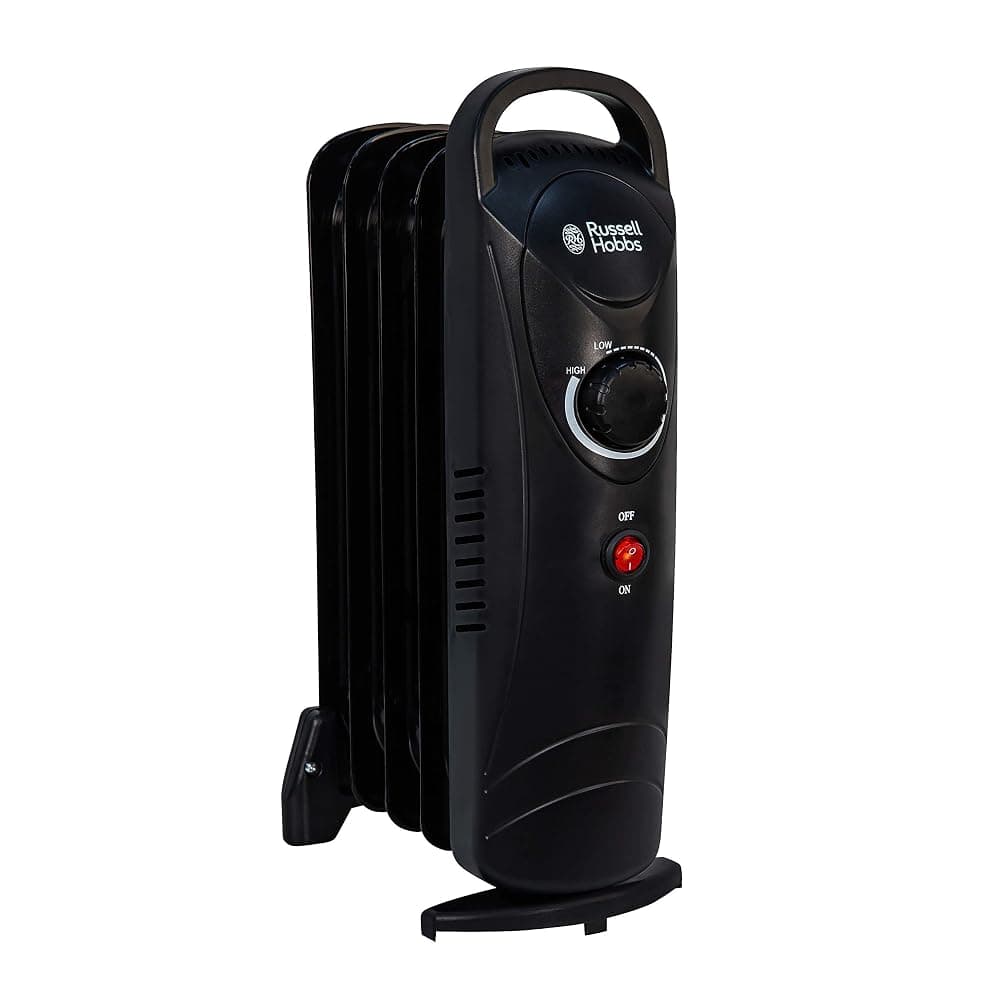
Russell Hobbs 650W 5-Fin Oil Filled Radiator with Adjustable Thermostat, Black (RHOFR3001)
Best for: Box rooms, small bedrooms and home offices up to about 10m².
This Russell Hobbs radiator is deliberately small: 650W from five oil-filled fins, rated by Russell Hobbs for rooms up to 10m². That makes it a good fit for a box room, a student bedroom or the corner of a room you work in all day, where a 2kW heater would be overkill and expensive to leave on. Like any oil-filled radiator it takes a while to warm up, then gives silent, even heat that lingers after the thermostat cuts out. It has a thermostat dial and overheat protection, and the listing also states tip-over protection. There is a single power level and no timer. At 38cm tall and 2.8kg it fits under a desk and is easy to carry between rooms.
Pros
- 650W draw keeps the hourly cost to roughly a third of a 2kW heater
- Silent, with no fan, so it suits bedrooms and video calls
- Compact (H38 x W13.5 x D25.5cm) and light at 2.8kg
- Second year of warranty free when you register it with Russell Hobbs
Cons
- Too small for most living rooms or a large, draughty room in January
- One power level and no timer
- Slow to warm a cold room from scratch, like all oil-filled radiators
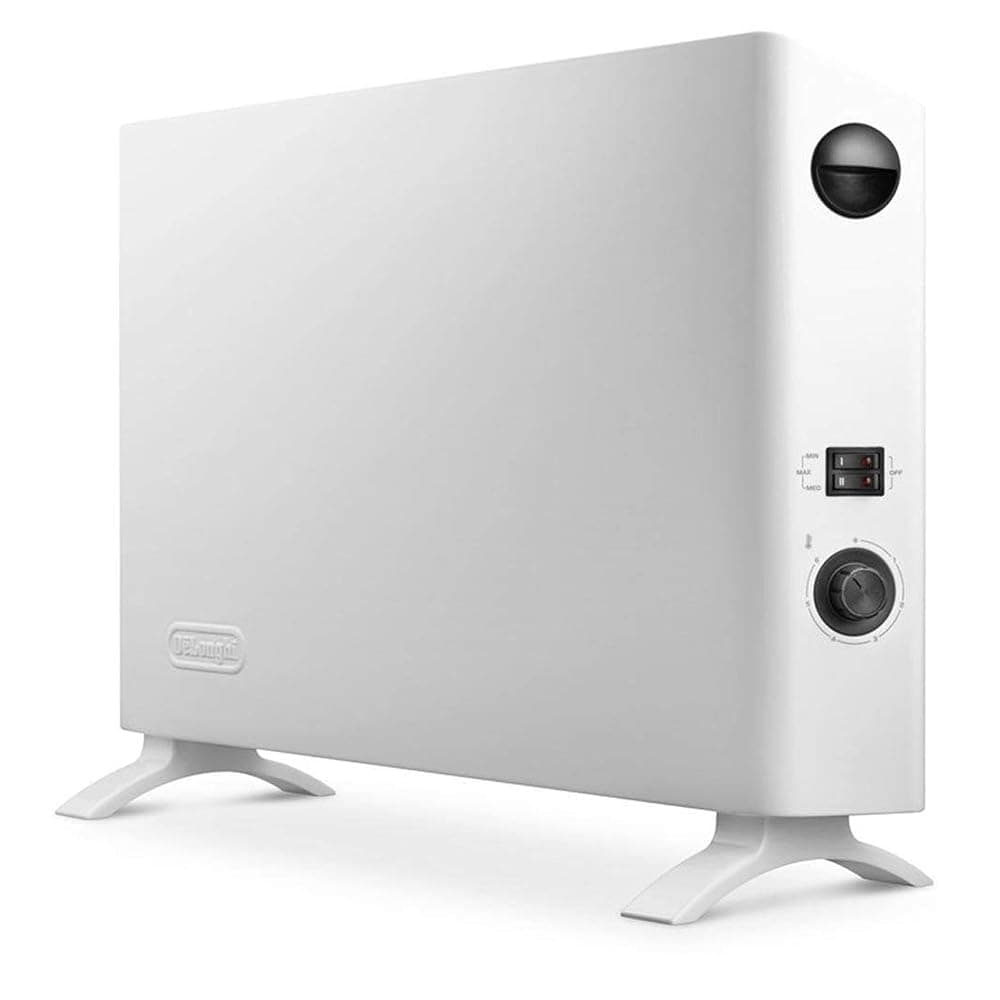
De'Longhi HSX2320 2kW Slim Convector Heater with Thermostat and Anti-Frost Setting, White
Best for: Bedrooms, home offices and living rooms that need warming up quickly.
The De’Longhi HSX2320 is a slim freestanding convector, only 9cm deep, that warms a bedroom or a medium living room much faster than an oil-filled radiator. Three power settings (800W, 1,200W and 2,000W) are the feature that matters most for your bill: use the full 2kW to bring the room up to temperature, then drop down and let the thermostat hold it. An anti-frost function switches it on if the room falls below 5°C, which suits a utility room, garage or holiday home over the winter. It weighs 4kg, has carry handles and plugs straight in. There is no timer, and the heat fades quickly once it switches off. De’Longhi itself pitches it for occasional use and spot heating, so if you will sit in the same room all day, every day, an oil-filled radiator gives steadier, quieter warmth.
Pros
- Three power settings, from 800W up to 2kW
- Thermostat plus anti-frost protection below 5°C
- Slim 9cm depth sits flat against a wall
- Light (4kg) with built-in carry handles; the listing states a three-year warranty
Cons
- No timer or smart controls
- Heat fades quickly once it cycles off, unlike an oil-filled radiator
- The grille gets hot, so keep it away from curtains and small children
2kW-plus oil-filled radiators worth considering
Links open an Amazon.ie search filtered to items sold & dispatched by Amazon.ie. Availability changes.
- Search Amazon.ie
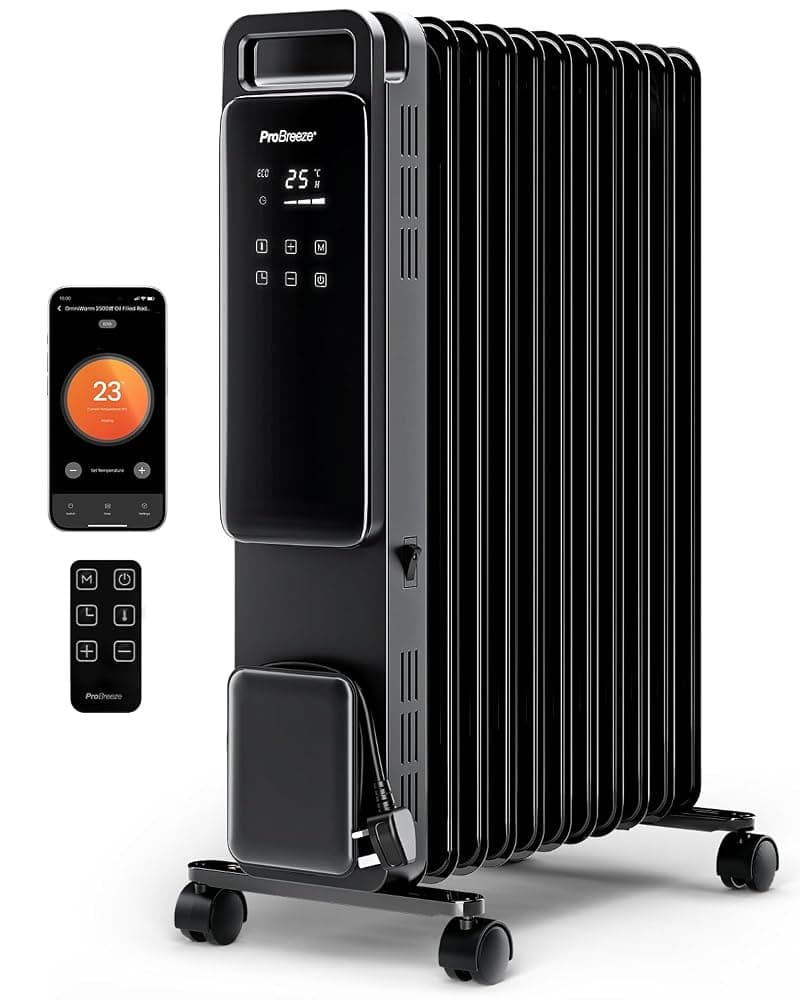
Pro Breeze Smart 2500W 11-fin oil-filled radiator
A large radiator with a digital display, a timer and several heat modes, with app control on the smart version, according to the listing. The top 2.5kW setting costs about 80c an hour flat out, so drop to a lower mode once the room is warm. Amazon.ie’s own stock of bigger radiators comes and goes in autumn, so if this link turns up nothing, check back or look at the De’Longhi above.
- Search Amazon.ie
De’Longhi Dragon 4 oil-filled radiator
A long-running oil-filled range with an adjustable thermostat and several power settings. Check the exact model’s wattage and whether it has a timer, and confirm the listing shows a UK/Irish 3-pin plug.
- Search Amazon.ie
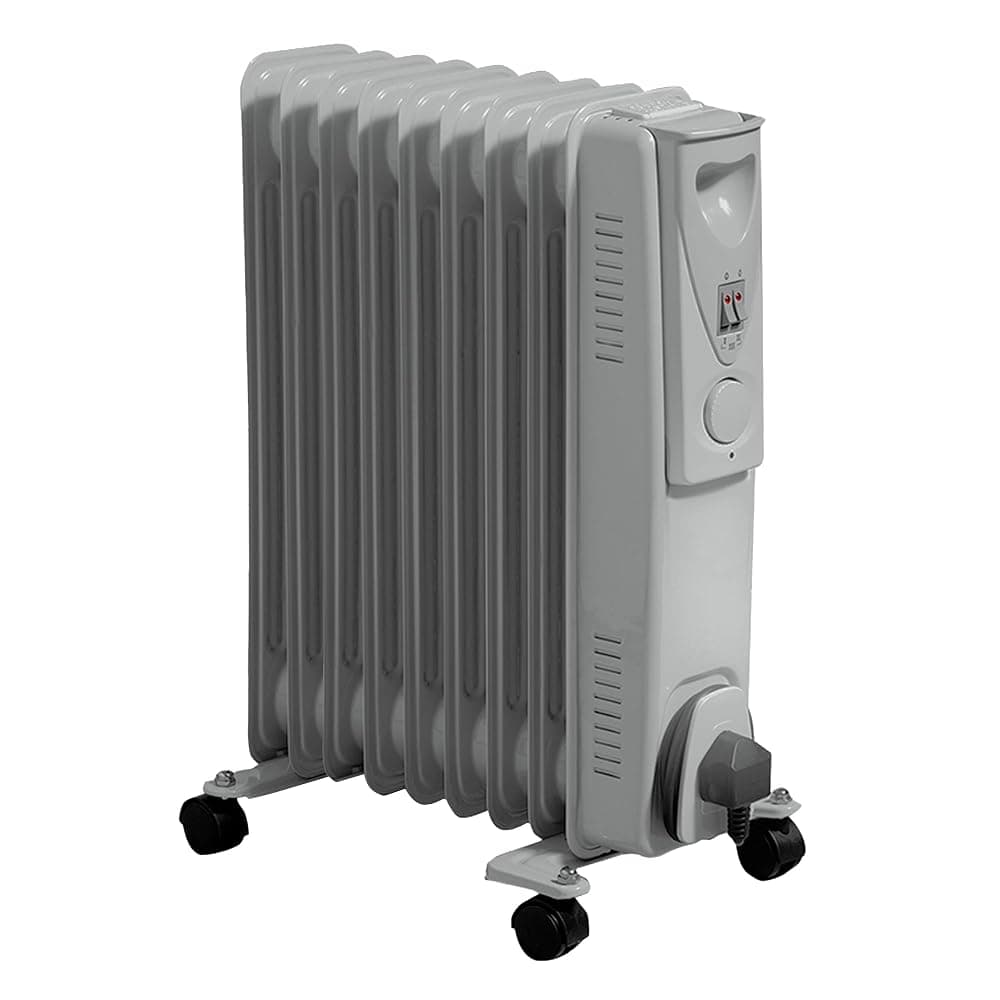
Daewoo 2000W oil-filled radiator
A simpler 2kW radiator with a thermostat, per the listing. Check the number of power settings and whether there is a tip-over switch before buying.
The Dublin Drop — Friday Deals
Price drops on Amazon.ie stock, once a week. No customs fees, no spam.
Free. No spam. Unsubscribe anytime. We only send verified domestic deals.
Our picks side by side
| Russell Hobbs RHOFR3001 | De’Longhi HSX2320 | Typical 2kW oil-filled radiator | |
|---|---|---|---|
| Type | Oil-filled radiator | Convector | Oil-filled radiator |
| Maximum power | 650W | 2,000W | 2,000W |
| Power settings | One | Three (800W, 1,200W, 2,000W) | Usually three |
| Thermostat | Yes (dial) | Yes (dial) | Yes, dial or digital |
| Timer | No | No | On some models |
| Frost protection | No | Yes, below 5°C | On some models |
| Room size (manufacturer) | Up to 10m² | Small and medium rooms | Often up to about 20m² |
| Size and weight | H38 x W13.5 x D25.5cm, 2.8kg | H46 x W68.3 x D9cm, 4kg | Bulkier and heavier, usually on castors |
| Maximum cost per hour | About 21c | About 64c (26c on 800W) | About 64c |
Oil-filled, convector, fan, panel and bathroom heaters compared
| Type | Heats up | Noise | Best for | Watch out for |
|---|---|---|---|---|
| Oil-filled radiator | Slowly (15–30 minutes) | Silent | Long sessions in one room | Heavy; surfaces get hot |
| Convector | Quickly | Quiet (louder with a turbo fan) | Warming a room up fast | Heat fades soon after it switches off |
| Ceramic or fan heater | Almost instantly | Noticeable fan noise | Short bursts in small spaces | Only warm while running; never leave on unattended |
| Panel heater (wall-mounted) | Quickly | Silent | Permanent heating in an extension or flat | Fixing to the wall; best with a 7-day timer |
| Bathroom heater or towel rail | Varies | Varies | Bathrooms and en suites | Must be IP-rated and wired in by an electrician |
Oil-filled radiators heat sealed oil inside the fins, which then radiates and convects heat into the room. They are slow to start but keep giving heat after the thermostat switches the element off, which evens out the temperature and suits a room you will be in for hours. Convectors heat air directly and push it out of the top grille, so they warm a cold room faster but cool down sooner. Some add a "turbo" fan for an even quicker start.
Ceramic fan heaters blow air over a hot ceramic element. They are compact and cheap to buy, and they warm the space right in front of them within a minute, but the fan is audible, the heat stops the moment they switch off, and running one at 2kW or more for hours adds up quickly. Panel heaters are essentially convectors in a slim case that can usually be wall-mounted. If you are fitting one as permanent heating, look for a model with an electronic thermostat and a 7-day timer; since 2018, EU ecodesign rules (often called Lot 20) have pushed makers to fit fixed electric heaters with electronic thermostats and extra controls such as a weekly timer.
Convectors, fan heaters and panel heaters to search for
Links open an Amazon.ie search filtered to items sold & dispatched by Amazon.ie. Availability changes.
- Search Amazon.ie
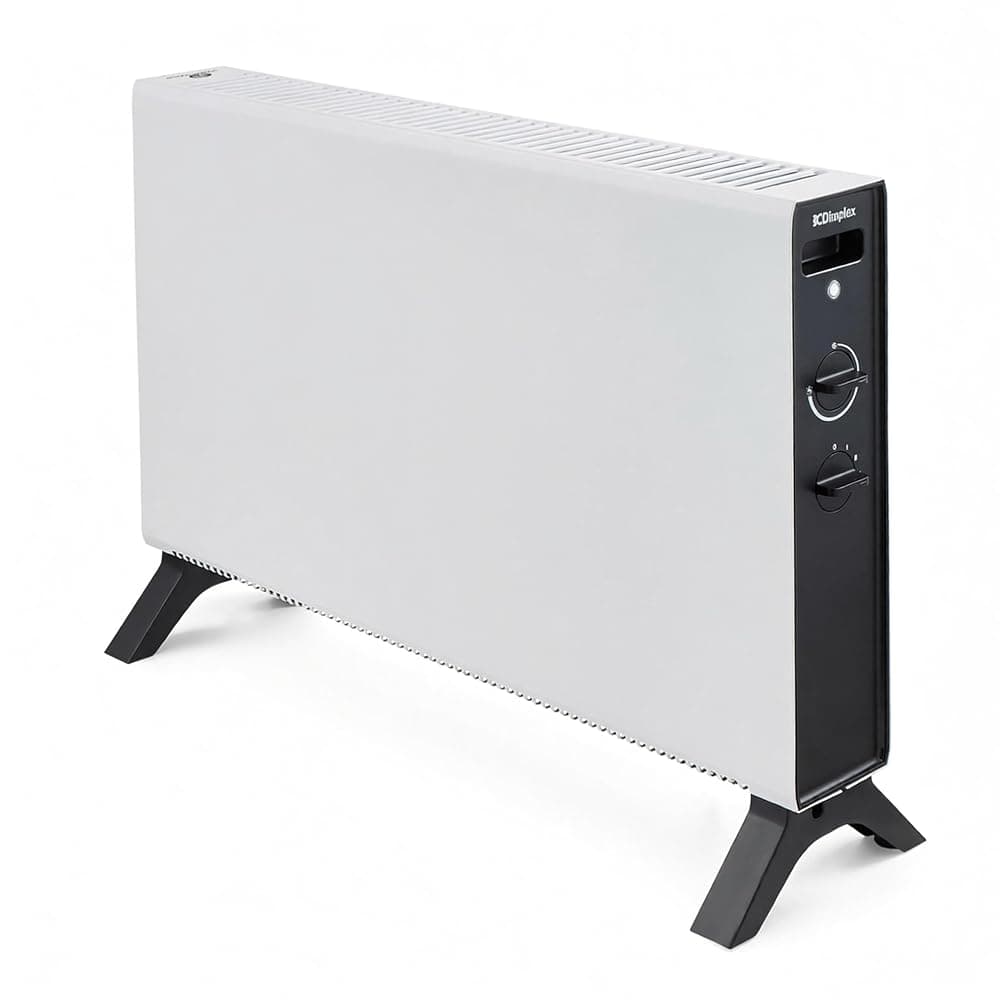
Dimplex 2kW convector heater
Dimplex makes a wide range of freestanding convectors. Look for three heat settings, an adjustable thermostat and frost protection, and check that the listing shows a UK/Irish 3-pin plug.
- Search Amazon.ie
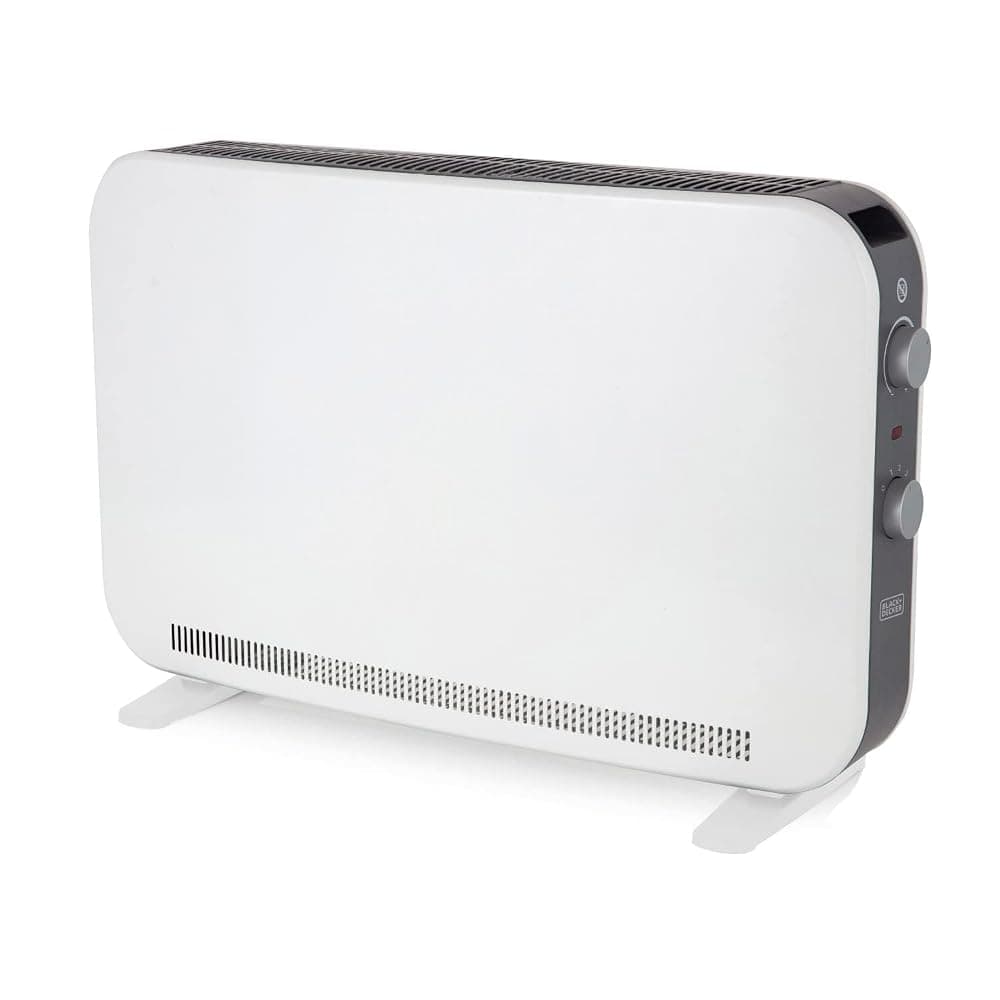
BLACK+DECKER 2kW convector heater
A basic portable convector. Compare its power settings, thermostat and anti-frost setting with the De’Longhi above before you buy.
- Search Amazon.ie
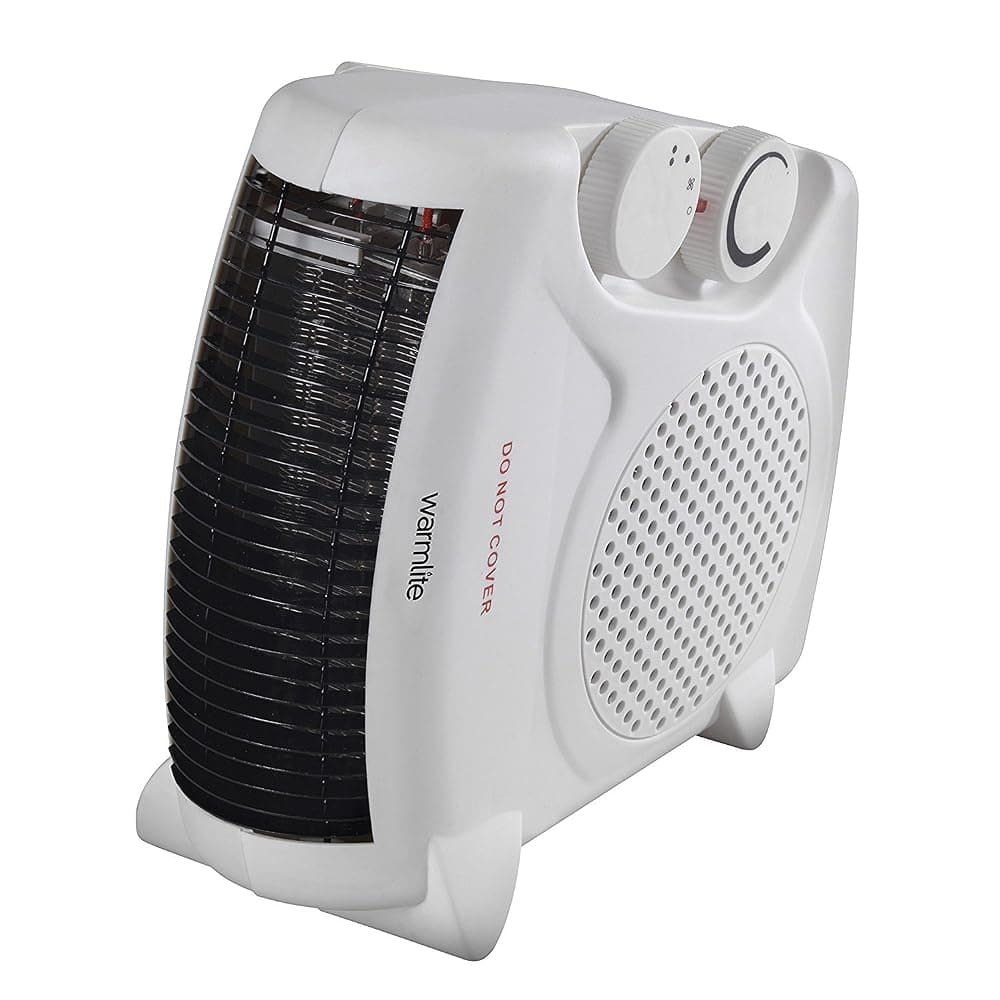
Warmlite 2kW fan heater
A low-cost fan heater. Look for two heat settings, a thermostat and overheat protection. Fine for a quick burst in a utility room or small office; not for heating a room all evening.
- Search Amazon.ie
Wall-mountable panel heater with a 7-day timer
For an extension, attic room or granny flat. Check the wattage, whether it plugs in or needs to be wired on a fused spur, and the room size the manufacturer quotes.
What an electric heater costs to run in Ireland
The sum is simple: watts ÷ 1,000 × hours × your unit rate. We have used 32c per kWh including VAT, a typical standard unit rate in Ireland at the time of writing. Your rate may be higher or lower, standing charges are on top, and if you are on a smart time-of-use plan, the 5pm–7pm peak is usually the dearest time of day, which is exactly when most people switch a heater on. Check your bill for your own figure.
| Power setting | Energy per hour | Cost per hour | Example |
|---|---|---|---|
| 650W | 0.65 kWh | About 21c | Russell Hobbs RHOFR3001 |
| 800W | 0.8 kWh | About 26c | Low setting on many 2kW heaters |
| 1,200W | 1.2 kWh | About 38c | Medium setting on many 2kW heaters |
| 2,000W | 2 kWh | About 64c | Most convectors and oil-filled radiators at full power |
| 2,500W | 2.5 kWh | About 80c | Larger oil-filled radiators at full power |
| 3,000W | 3 kWh | About 96c | The most a 13A plug can supply; some fan heaters |
A worked example: a 2kW heater used for four hours on a winter evening costs up to about €2.56 if it never switches off. If the thermostat keeps it on for about 60% of the time once the room is warm, that falls to around €1.54. Over 100 evenings, that is the difference between roughly €256 and €154, which is why a thermostat and lower power settings matter more than the type of heater. The small 650W radiator running flat out for the same four hours costs about 83c, but it will only keep a small room comfortable.
Heating a bathroom safely
Bathrooms are treated as special locations under the Irish wiring rules, because water and electricity are a dangerous mix. A portable plug-in heater should never be used in a bathroom or shower room, and an extension lead should never be run in from the landing. The right answer is a fixed heater or electric towel rail designed for bathrooms, installed in a permitted position by a qualified electrician.
- Check the IP rating. The second digit shows protection against water: IPX4 means protected against splashing from any direction, and the manual will say which bathroom zones the heater can go in. Higher ratings are needed closer to the bath or shower.
- Use a Registered Electrical Contractor. Electrical work in a bathroom is classed as "controlled work" in Ireland, so it should be done and certified by a contractor registered with Safe Electric. That includes wiring in a bathroom heater that arrived with a plug fitted.
- Controls out of reach. Wall-mounted bathroom heaters usually use a pull cord or are positioned so they cannot be reached from the bath or shower.
- Consider a towel rail. An electric towel rail draws far less power than a 2kW fan heater, takes the chill off a small bathroom and dries towels, which also helps with damp.
Bathroom heating to search for
Links open an Amazon.ie search filtered to items sold & dispatched by Amazon.ie. Availability changes.
- Search Amazon.ie
Wall-mounted downflow bathroom fan heater
Designed to be fixed high on a wall and wired in, giving a quick blast of heat while you get ready. Check the IP rating and permitted zones in the manual before you book the electrician.
- Search Amazon.ie
Electric heated towel rail
Look for the wattage, the IP rating and whether it is dry-element or fluid-filled. In a bathroom it should be wired in by a registered electrician.
What to look for when buying
- Size it to the room. Manufacturers quote a room size: around 10m² for a 650W radiator and up to about 20m² for many 2kW heaters. Treat these as a guide for a reasonably insulated room, and allow more for an older, draughty house or a room with a lot of glass.
- Several power settings. Three settings (for example 800W, 1,200W and 2,000W) let you warm the room at full power and then hold it on a lower one. This saves more money than any other feature.
- A thermostat. Essential. Dial thermostats are marked in numbers rather than degrees, so you find the right setting by trial and error; digital thermostats hold a set temperature more precisely.
- A built-in timer. A 24-hour or 7-day timer lets you warm a room before you get up or come home. Use the heater’s own timer: many heater manuals warn against plugging them into a separate timer or smart plug that could switch them on when nobody is there.
- Frost protection. An anti-frost setting switches the heater on at around 5°C to stop pipes freezing in a garage, utility room or holiday home over a cold snap.
- Tip-over switch and overheat cut-out. Do not buy a heater without both, especially with children, pets or a busy hallway.
- An Irish/UK 3-pin plug. Some heaters sold online are EU models with a two-pin plug. Running a 2kW heater through a travel adaptor for hours is a fire risk, so choose a listing with a fused 3-pin plug and check the plug type on the product page. We explain why we only list Amazon.ie stock separately.
- Buy before the cold snap. Heaters sell out quickly when the first frost arrives. Some are discounted around Black Friday, but if you need one now, the money saved is rarely worth weeks of a cold room.
Electric heater safety
- Keep heaters at least a metre from curtains, bedding, sofas and anything else that can burn.
- Never dry clothes on or over a heater, and never cover one. For laundry, a dehumidifier is safer and cheaper; see our dehumidifier guide.
- Switch portable heaters off when you go to bed or leave the house, particularly fan heaters.
- Stand heaters on a flat, stable floor where they will not be knocked over, and keep them out of the way of doors and walkways.
- Make sure you have working smoke alarms, and test them regularly.
Everything on this page is limited to stock sold and dispatched by Amazon.ie, so there are no UK import charges at the door and your EU consumer rights apply. For more ideas, see all our home guides, the Home & Kitchen category, or our smart home guide, which covers smart plugs with energy monitoring for working out what lower-power appliances cost to run.